
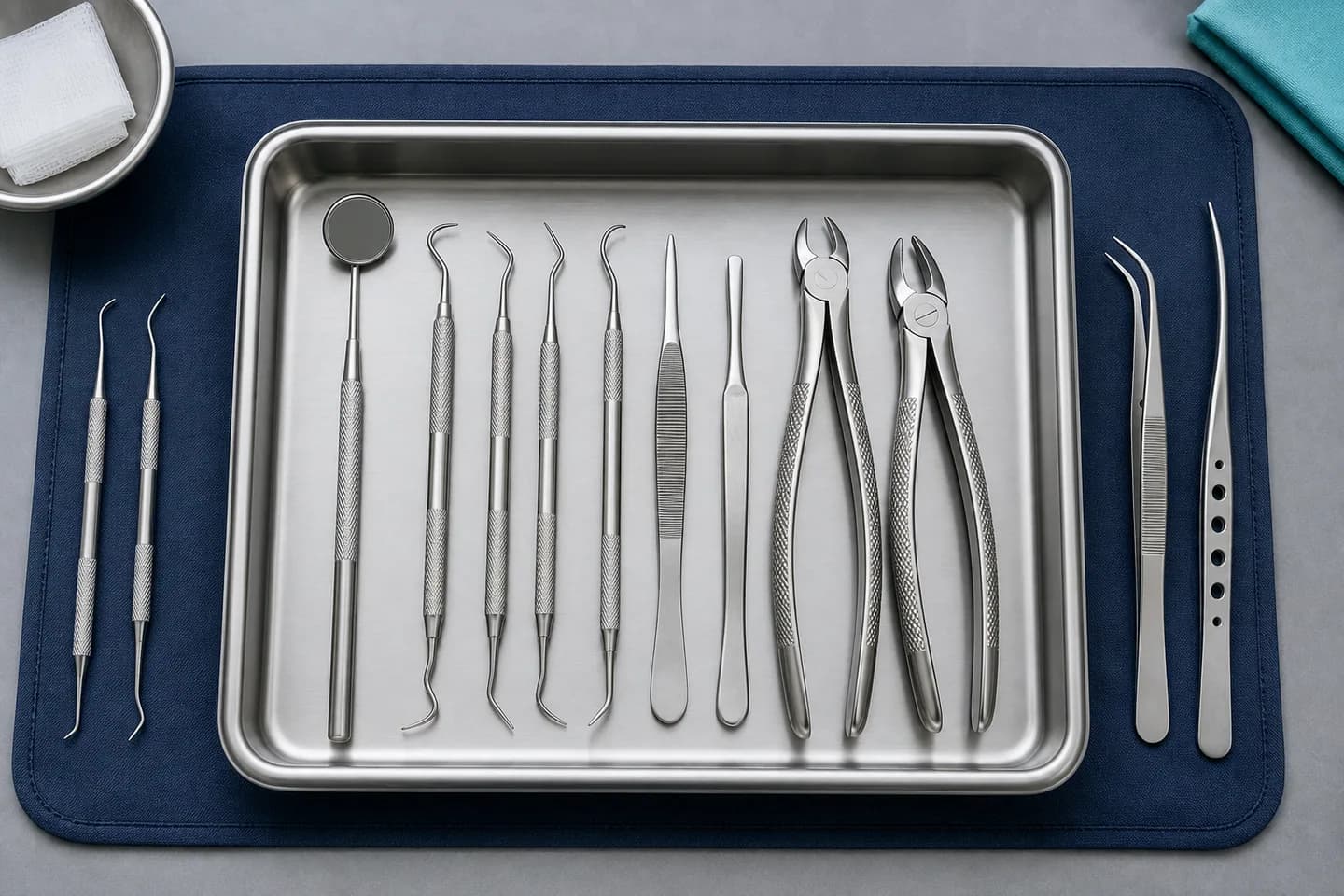
Dental burnishers are restorative hand instruments that smooth, adapt, contour, and refine restorative materials before final carving, finishing, and polishing. They are used most in amalgam, composite, temporary-filling, and matrix-band workflows, and the right burnisher depends on the restoration type, tooth anatomy, material, and access. Unlike a carver (which cuts anatomy) or a condenser (which packs material), a burnisher applies controlled pressure with a smooth working end.
What is a dental burnisher?
A dental burnisher is a hand instrument with a smooth blade or nib used to press, blend, adapt margins, contour anatomy, and smooth the surface of a restoration. Good marginal adaptation matters because a poorly adapted margin creates overhangs, roughness, plaque traps, and sensitivity. The burnisher differs from two similar instruments: a condenser packs restorative material into the preparation, and a carver cuts or defines anatomy with a sharper end, while the burnisher smooths and pre-contours with a rounded or polished end. Some instruments, such as the Woodson, combine a condenser and a paddle burnisher in one.
Main types of dental burnishers
| Burnisher | Working end | Best for |
|---|---|---|
| Ball | Smooth, rounded | Marginal adaptation, matrix contouring, small contours |
| Football | Elongated oval | Occlusal surfaces, broad posterior smoothing |
| Acorn | Pointed acorn shape | Pits, grooves, fossae, pre-carving occlusal anatomy |
| T-ball | Ball plus paddle | Matrix contouring, initial anatomy |
| Beavertail | Flattened paddle | Facial and lingual walls, broad surfaces, temporaries |
| Woodson | Condenser + paddle | Temporary materials, liners, tight-access smoothing |
Browse restorative instruments.
Dental burnishers by clinical use
Burnisher use depends on the restorative material. In amalgam restorations, burnishers smooth the material after condensation, adapt it toward margins, contour the matrix band, and begin anatomic form in the sequence condense, burnish, carve, check occlusion, finish, polish. In composite workflows the instrument is used more for contouring and smoothing than true burnishing, since resin does not burnish like a metallic material; non-stick or titanium-nitride-coated tips help shape uncured resin, blend increments, and reduce rotary finishing. Temporary and provisional materials benefit from broad, smooth adaptation, and ball or T-ball burnishers help contour a matrix band before placement without tearing it.
How to select the right dental burnisher
Select by material, working-end shape, and tip size. For amalgam, use polished stainless steel that tolerates adaptation pressure; for composite, consider non-stick or coated tips that reduce drag. Match the working end to anatomy: acorn and football for occlusal anatomy, ball or T-ball for matrix contouring, beavertail or paddle for broad facial and lingual walls. Size the tip to the restoration — smaller ball or acorn tips for conservative and pediatric preparations, larger football or beavertail ends for molars and broad surfaces. The instrument should feel stable in a modified pen grasp without twisting, and the working end must be smooth: a scratched, pitted, or bent tip drags composite and marks amalgam, so replace damaged instruments rather than compromise the surface.
Common mistakes to avoid
- Using a burnisher like a carver — it smooths and pre-contours; use a carver for sharp anatomic definition.
- Overworking composite — light pressure and incremental shaping prevent slumping and pull.
- Ignoring matrix adaptation — a burnisher shapes the band but cannot rescue a poorly seated matrix or wedge.
- Keeping worn instruments — a rough tip compromises the restoration surface.
Frequently asked questions
What are dental burnishers used for?
Burnishers smooth, adapt, contour, and refine restorative materials such as amalgam, composite, and temporary fillings, and help contour matrix bands before material placement.
What is the difference between a ball burnisher and an acorn burnisher?
A ball burnisher has a rounded end for smoothing, margin adaptation, and matrix contouring; an acorn burnisher has a pointed acorn tip used to begin occlusal anatomy and refine posterior contours.
Can burnishers be used with composite?
Yes, burnisher-shaped instruments smooth and shape composite, but the instrument is used for contouring and surface refinement before curing rather than true metallurgical burnishing.
Building a restorative tray? Request a quote for burnishers, carvers, and condensers.