
Dental Cassettes and Instrument Trays
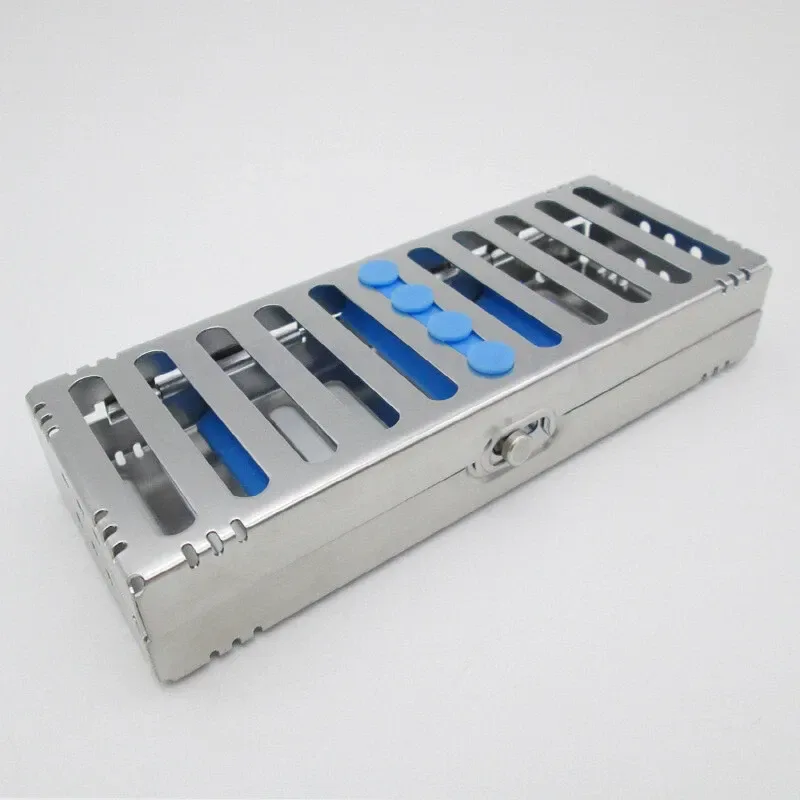
Sterilization Cassette 5-Slot
A dental instrument cassette with five holding positions, a slotted metal body and lid, blue internal holding components and closure hardware. Sold as one cassette; instruments are not included.
Cassette or Open Tray: Check Five-Position Fit Before You Order
Choose a cassette when each instrument must stay in its own position, protected through handling and reprocessing. Choose an open tray when you only need to lay out a procedure setup. The listed five-slot cassette is one empty cassette, so check that your five instruments fit it before you order.
Cassette or Tray, Then Instrument Fit and Equipment Space
Only the five-slot cassette is listed as a ready-to-order product here. Cassettes in other capacities and open trays are quoted from your requirements. Decide on the type first, then compare measurements.
Five positions describe capacity, not instrument size. A set of five instruments fits only when three conditions are met. The longest instrument, the widest handle and any hinged instrument must clear the usable inside space and the closed lid. Each handle must also sit in its own holder. Ask for the usable inside length and width, the closed-lid clearance and the holder spacing. Compare those figures with your own instruments rather than judging fit from a photograph.
Next, check the closed cassette's outside size against your washer, ultrasonic unit, packaging and sterilizer space. Processing follows the instructions for the cassette, its holding components and your instruments, within your facility's process.
| Selection | What to compare | Order record |
|---|---|---|
| Five-slot cassette (listed, one empty cassette) | Usable inside length and width, closed-lid clearance, holder spacing, closure action | Product name, number of cassettes, five-instrument layout, destination |
| Cassette in another capacity (quoted) | Positions needed, retention method (slots, rails or mat), perforation, closure | Target capacity, internal and external dimensions, retention component reference |
| Open tray (quoted) | Working area, depth, edge profile, perforated or solid construction, handle or cover | Length, width, depth, edge form, equipment-space limits |
| Repeat or replacement cassette | The same approved layout, dimensions and retention features as the earlier order | Original product reference, capacity, rail or mat specification, approved layout |
What the photograph shows
The five-slot sterilization cassette, closed and viewed at an angle. The photograph shows only the outside of the cassette. It does not show an opened view or any measurements.
- Slotted lid
This is the top surface. Its openings are part of the slotted metal enclosure that keeps the instruments together. The lid is not a sterile barrier.
- Blue components
These are visible within the closed enclosure. They are the internal holding components that keep each instrument in its own position. The visible blue parts are not a count of slot positions, and their colour does not indicate a material or temperature rating.
- Front latch
This sits at the front edge. It is the closure hardware that holds the body and lid together. Check that it remains easy to operate with your layout in place.
- Closed, angled view
This view shows the external form only. Ask for the interior layout, holder spacing and usable dimensions in your quotation.
Prepare your request
Fill in one line for each position, naming the instrument you plan to place there and adding measurements taken from that instrument. Leave the cassette figures blank. We confirm them in the quotation so you can compare them with your instruments.
This is a blank planning record for illustration only. It is not a stocked configuration, and it does not mean that any five instruments will fit. Keep the approved record with your order, and send an updated copy for a fit review if an instrument changes before a repeat order.
Dental Cassettes and Instrument Trays Buying Specifications
| Specification | Details |
|---|---|
| Listed cassette | Sterilization Cassette 5-Slot: one cassette, five instrument positions, slotted metal body and lid, blue internal holding components, closure hardware; supplied empty |
| Cassette selection | Slot capacity, external and internal dimensions, perforation, closure, rails or mat, and instrument retention |
| Tray selection | Length, width, depth, perforated or solid construction, rim, handle or cover where present |
| Workflow | Instrument retention and protection (cassette) versus open procedure organization (tray) |
| Compatibility | Material and processing methods stated in the exact product instructions |
| Order details | Product or capacity, dimensions, quantity, marking, packaging and destination |
Dental Cassettes and Instrument Trays FAQ
How does an instrument cassette differ from an open tray?
A cassette provides a defined arrangement for retaining instruments during handling and an applicable processing workflow. An open tray provides an area for organizing instruments. Compare retention and closure when selecting a cassette, and usable area and depth for a tray. The processing instructions for the selected product remain a separate check.
Does the five-slot cassette come with instruments?
No. The five-slot cassette is supplied empty, and five slots describe the positions inside one cassette, not five included instruments or a pack of five cassettes. Instruments are a separate order, and we can quote them with the cassette when you send the instrument list.
Does a five-position cassette fit any five instruments?
No. Position count is only one fit criterion. Compare usable internal dimensions, the longest instrument, handle widths, spacing and room for hinged instruments; a layout of the actual selected instruments is more useful than a total count. Also check the closed cassette's dimensions against your equipment and packaging space.
Which cassette features should I compare after checking dimensions?
Compare the retention arrangement, closure, perforations and access for inspecting the contents. Check whether the specified instruments remain in their intended positions and whether the latch and internal supports suit that layout. Any replaceable support or mat needs its own reference; external size alone does not identify a matching cassette.
Does a cassette make its contents sterile without a separate process?
No. A cassette organizes instruments; it does not perform sterilization. The instrument, cassette and equipment instructions govern the processing and packaging arrangement, so evaluate them together with your facility's workflow before choosing a container. No single cleaning or sterilization cycle can be inferred from a cassette's name or appearance.
How should a cassette be specified with a new instrument kit?
Attach the itemized instrument list and a numbered layout, including long or hinged instruments and any separate accessories. Record the cassette's usable dimensions and retention requirements against that layout. Keep the approved combination with the order so adding a new instrument later triggers a fit check rather than relying on the original piece count.
Need Dental Cassettes & Trays in Bulk?
Send your instrument list and quantities for manufacturer-direct pricing, custom branding, or mixed-category quotes.