
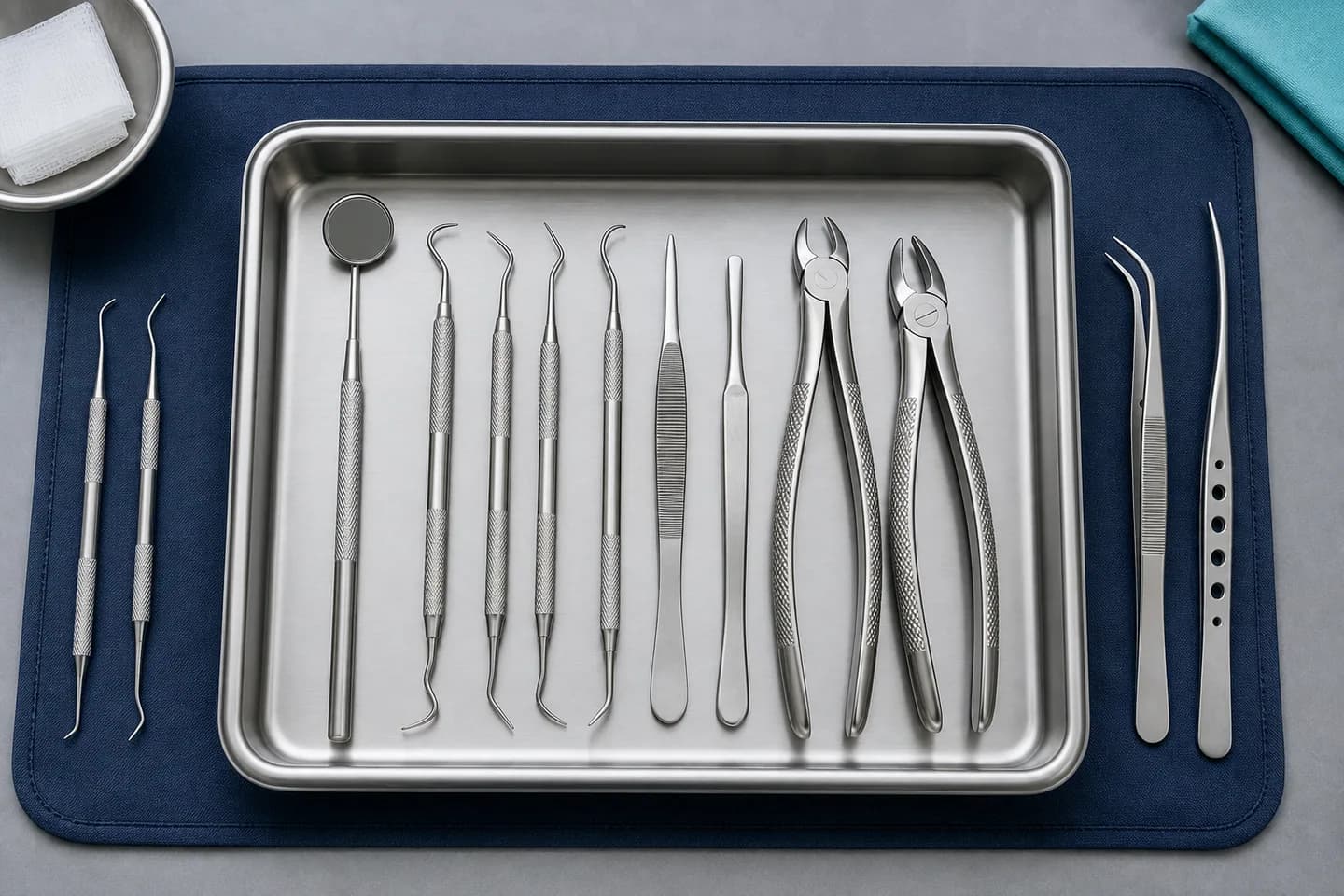
Wholesale dental instruments are purchased in bulk directly from a manufacturer at lower per-unit prices than retail or distributor channels. Buying wholesale suits clinics standardizing instruments, dental schools equipping cohorts, and distributors reselling under their own brand. This guide explains how wholesale pricing works, typical order minimums, how to vet a supplier, and the ordering process.
What does wholesale dental instruments mean?
Wholesale means buying instruments in quantity, typically direct from the manufacturer, at a price per unit that falls as volume rises. It differs from retail purchasing, where each instrument carries the full markup added by importers and distributors. Wholesale buyers trade a larger order commitment for a lower unit cost and, often, the option to customize patterns and branding.
How does buying wholesale save money?
Wholesale saves money by removing the markups added at each step between the workshop and the practice. A typical retail instrument passes through manufacturer, exporter, importer, and distributor, each adding margin, so the buyer can pay several times the production cost. Buying direct from the manufacturer collapses that chain, which is why manufacturer-direct wholesale pricing is often 50 to 75 percent below distributor pricing for the same instruments.
What are typical minimum order quantities?
Minimum order quantities (MOQs) vary by whether instruments are standard catalog patterns or customized. As a general guide:
- Standard catalog instruments: low minimums, often from a handful of pieces per pattern.
- Custom branding / private label: higher minimums, commonly from around 25 pieces per pattern, to justify the setup.
- Sample orders: small evaluation quantities (1–3 pieces) are usually available before a bulk commitment.
Always request a sample before standardizing a large order.
How to vet a wholesale dental instrument supplier
Vet a supplier by verifying quality signals and documentation before committing to volume:
- Confirm the steel grade and hardness range, and whether instruments are forged.
- Ask for ISO 9001 or ISO 13485 certificates and CE conformity where applicable.
- Request samples and evaluate finish, joint movement, and pattern accuracy.
- Check batch consistency, lead times, and return or warranty terms.
- Confirm packaging, labeling, and shipping/tracking arrangements.
Our guides on evaluating instrument quality and instrument materials cover what to check in detail.
The wholesale ordering process, step by step
- Send your instrument list with patterns and quantities and request a quote.
- Order samples of your highest-volume patterns and approve quality.
- Confirm specifications, branding, pricing tiers, and lead time.
- Place the production order and approve any pre-production sample.
- Receive the shipment with tracking, then inspect against your list.
Start with our wholesale dental instruments page, or request a quote directly.
Custom branding and private label
Wholesale orders can include custom laser engraving and private-label packaging so distributors and group practices sell instruments under their own brand. Private label typically carries a higher MOQ than plain catalog instruments because of the added setup. See our OEM and private labeling service for details.
Frequently asked questions
What is the minimum order for wholesale dental instruments?
Standard catalog instruments often have low minimums (a few pieces per pattern), while custom-branded instruments commonly start from around 25 pieces per pattern. Sample orders of 1–3 pieces are usually available first.
How much cheaper is wholesale than retail?
Manufacturer-direct wholesale pricing is often 50 to 75 percent below distributor pricing because it removes the importer and distributor markups added along the supply chain.
Can I get my own brand on wholesale instruments?
Yes. Custom laser engraving and private-label packaging are available on bulk orders, usually with a higher minimum order quantity than plain catalog instruments.
Buying in bulk? Send your list and quantities for tiered wholesale pricing.