
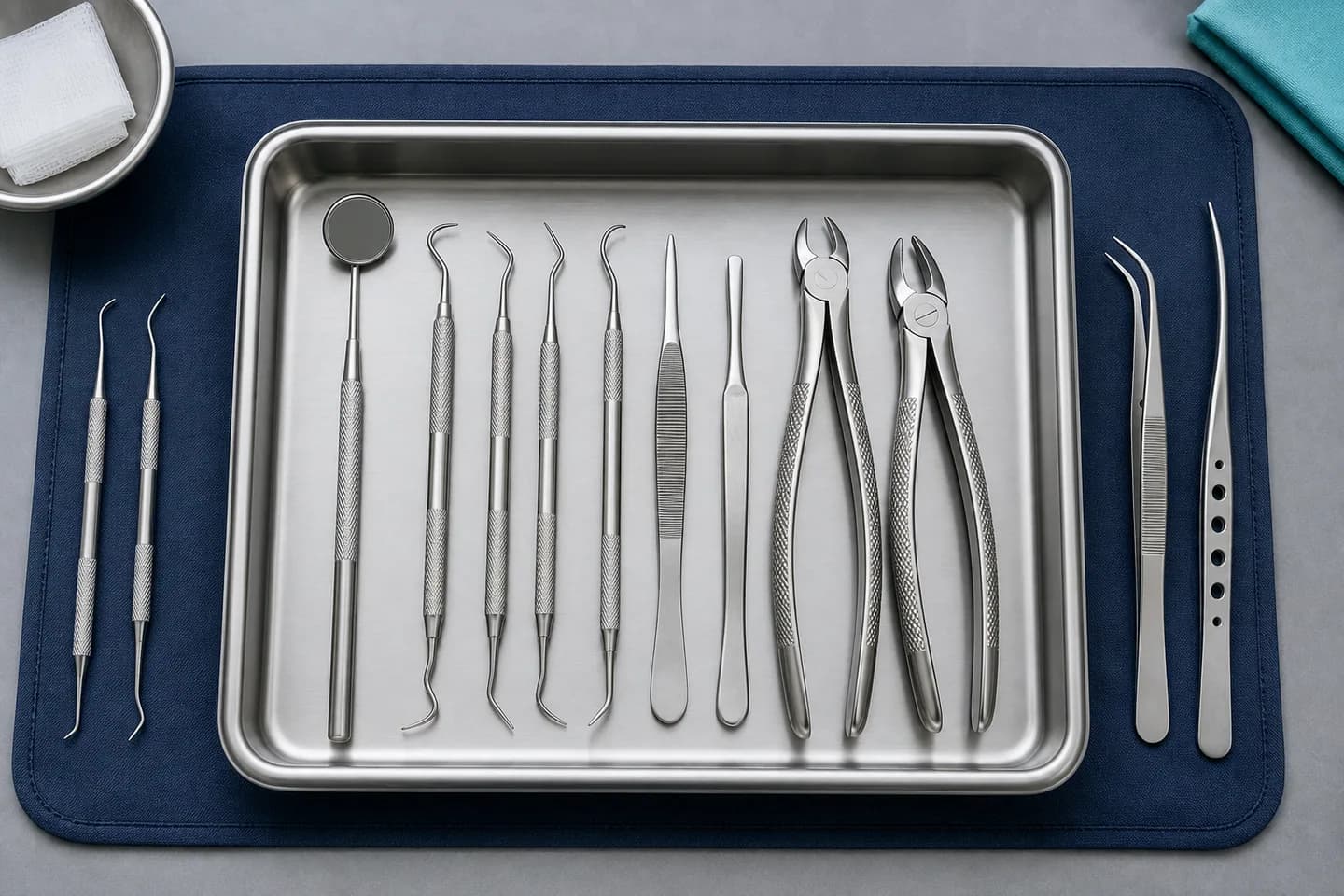
Dental mirrors are diagnostic instruments used for indirect vision, reflecting light, retracting soft tissue, and improving access to areas the clinician cannot see directly. The main types are front surface, plane, concave, double-sided, disposable, illuminated, and photographic mirrors, and each has a distinct clinical role. This guide explains what each type is best for, how sizes and handles differ, and how to keep mirrors clinically useful.
What is a dental mirror used for?
A dental mirror supports four core clinical functions: indirect vision to view areas that cannot be seen directly, soft-tissue retraction of the cheek, lip, or tongue, indirect illumination by reflecting light onto darker surfaces, and visual enhancement during diagnosis. Because the mirror is part of the clinician's visual system, image quality matters: a distorted, fogged, scratched, or dim mirror slows diagnosis, worsens ergonomics, and makes fine restorative and periodontal work harder.
Main types of dental mirrors
Front surface mirrors are the everyday workhorse because the reflective coating sits on the front of the glass, eliminating the double "ghost" image of back-surface mirrors and giving a sharp, distortion-free view for restorative margins, caries detection, hygiene, and endodontic access. The other types solve more specific problems, summarized below.
| Mirror type | Key feature | Best for |
|---|---|---|
| Front surface | Coating on front of glass; no ghost image | Restorative, hygiene, endodontics, detailed diagnostics |
| Plane (flat) | Normal, non-magnified reflection | Routine exams, screening, student kits, patient education |
| Concave (magnifying) | Curved to magnify; can distort if mis-angled | Close inspection of pits, fissures, small margins |
| Double-sided | Reflective on both faces | Posterior access, oral surgery, quick angle changes |
| Disposable | Single-use, plastic handle | Screenings, mobile clinics, outreach, limited sterilization |
| Illuminated | Integrated light source | Posterior and low-light visualization, mobile settings |
| Photographic | Large occlusal/buccal/lateral reflective plates | Case documentation, orthodontics, cosmetic records |
Browse diagnostic instruments for reusable mirrors and handles.
Dental mirror sizes and handle systems
Mirror heads come in several sizes, and the right size depends on access versus field of view. Smaller heads improve access in pediatric patients, tight posterior spaces, and rubber-dam isolation, while larger heads give a broader field for routine exams and photography. Common reference sizes are the #4 at about 22 mm and the #5 at about 24 mm, though dimensions vary by manufacturer.
Handles are not always interchangeable: cone-socket systems and simple-stem systems use different threaded connections, so confirm the connection type before ordering replacement heads. Handle ergonomics also affect fatigue; larger-diameter, textured, or lightweight handles reduce pinch force during long procedures. Standardize handles across procedure cassettes so the team is not switching grip styles.
Which dental mirror for which procedure?
Match the mirror to the procedure rather than using one mirror for everything. A front surface mirror is the default for detail work; larger or double-sided mirrors help with access and documentation.
| Procedure | Recommended mirror |
|---|---|
| Examination & diagnosis | Front surface, multiple sizes |
| Hygiene & periodontal care | Front surface with good fog control |
| Restorative dentistry | Front surface / high-definition |
| Endodontics | Small front surface (#3–#4) |
| Oral surgery & extractions | Durable front surface or double-sided |
| Orthodontics | Front surface chairside; photographic for records |
| Pediatric dentistry | Smaller front surface or disposable |
| Prosthodontics & implants | High-clarity front surface plus photographic |
How to choose the right dental mirror
- Identify the procedure, since exams, hygiene, restorative, surgery, orthodontics, and photography have different needs.
- Prioritize image clarity; use front surface mirrors where detail matters.
- Choose the size for access versus field of view.
- Confirm cone-socket or simple-stem handle compatibility before ordering.
- Evaluate handle ergonomics for control and reduced fatigue.
- Consider fog and scratch resistance, which affect chairside speed.
- Decide between reusable autoclavable mirrors and disposables for your infection-control workflow.
- Standardize the right mirror in each procedure cassette, and inspect and replace scratched or distorted heads.
Sterilization and infection control
Mouth mirrors are classified as semicritical items because they contact mucous membranes, and heat-tolerant semicritical instruments should be cleaned and then heat-sterilized between patients per CDC and ADA guidance. To keep mirrors clinically useful: clean debris before sterilization, avoid abrasive scrubbing that scratches the reflective surface, use cassettes to reduce mirror-to-metal contact, dry thoroughly before packaging, and replace mirrors that no longer give a clear image. For the full workflow, see our dental instrument sterilization guide.
Frequently asked questions
What are the main types of dental mirrors?
The main types are front surface, plane, concave, double-sided, disposable, illuminated, and photographic mirrors. Front surface mirrors are the everyday choice for detail work.
What is the best dental mirror for general dentistry?
A front surface mirror is usually best for general dentistry because it gives a sharper, distortion-free image than basic back-surface mirrors. Keep multiple sizes for different patients and procedures.
What is a concave dental mirror used for?
A concave mirror provides magnification for inspecting small details such as pits, fissures, and margins, but it can distort the image if the viewing angle is not controlled.
Why do dentists use mirrors instead of looking directly?
Mirrors give indirect vision of lingual surfaces, posterior teeth, and areas blocked by the cheeks, lips, or tongue, while also reflecting light and supporting better operator posture.
Standardizing your operatory mirrors? Request a manufacturer-direct quote for reusable mirrors and handles.