About Endodontic Forceps
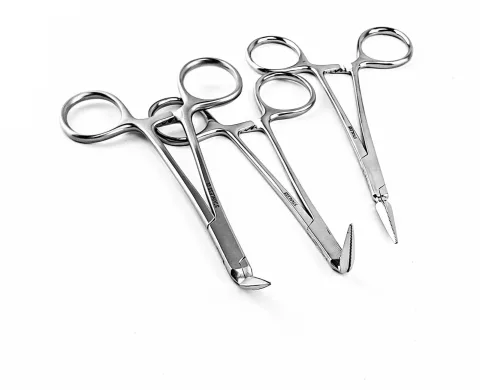
This Endodontic Forceps offer is a three-piece set of Williams Stieglitz fragment forceps: one straight, one 45-degree and one 90-degree pattern, each at a stated 5.5-inch length. Pointed, serrated jaws are made for grasping small, accessible materials during professional endodontic work, so the set belongs alongside your canal-access instruments rather than with tooth-extraction forceps. Buying the three patterns together puts each jaw orientation on the tray before the working view calls for it.
Three approach angles on one tray
- Straight: Jaw orientation: Jaws continue in line with the shafts; What it changes: Direct, in-line approach
- 45-degree: Jaw orientation: Jaws angled partway off the shaft line; What it changes: Intermediate change in approach direction
- 90-degree: Jaw orientation: Jaws turned at a right angle to the shafts; What it changes: Most pronounced change in approach direction
The three instruments share the same family design and differ in how the jaws sit relative to the shafts. On the straight forceps, the jaws continue along the shaft line, so the instrument approaches its target in the same direction the hand is pointing. The 45-degree pattern bends the jaws partway off that line, and the 90-degree pattern turns them fully to a right angle. Each step changes the direction from which the jaw tips meet the material.
That variety is the reason for supplying three patterns instead of one. Angle selection depends on the view and space you actually have, so the set does not assign a fixed angle to a particular tooth or arch. A straight instrument may be the natural first choice where the line of approach is open, while the angled patterns give alternatives when it is not. Having straight, intermediate and right-angle options together lets the clinician choose by the situation in front of them rather than by a rule written in advance.
Pointed serrations and a ratchet that holds closure
The working ends taper to pointed tips, and the inner faces of the jaws carry serrations. A pointed tip concentrates contact at the very end of the instrument, which suits small objects that leave little to hold. The serrated faces add texture where smooth jaws would offer only flat contact, helping the jaws keep purchase on what they close around.
Behind the hinge, each forceps has finger-ring handles and opposing ratchet bars. When the rings are brought together, the bars engage and hold the jaws closed, so the grip does not depend entirely on continuous finger pressure. This combination of finger rings and ratchet gives the forceps a controlled, retained closure, and it is a key difference between a fragment forceps and nonlocking tweezers.
These instruments are designed to grasp small material at the jaw tips. They are not extraction forceps for removing whole teeth, and they are not intended to stand in for a hemostat or a dedicated file holder.
Matching the set to the access you work in
An angled Stieglitz pattern is not automatically a micro-retrieval instrument. Whether any grasping forceps suits a case depends on the room available in the access, how clearly the material can be seen, and whether the jaw profile can reach it without crowding the opening. A 90-degree orientation changes the approach direction, but the angle alone does not establish how wide the jaws are or whether they suit a given access. The actual jaw profile and the space available decide that. When access is confined, compare the jaw profile you need with this pattern before ordering. This set is a defined pointed-tip Stieglitz offer at 5.5 inches, best evaluated against the access situations your practice routinely encounters.
Specifications for ordering and reorders
- SKU: DIS-DEN-0219
- Contents: 3 forceps: straight, 45-degree, 90-degree
- Pattern: Williams Stieglitz fragment forceps
- Stated length: 5.5 in
- Tips: Pointed, serrated
- Handles: Finger rings with ratchet lock
- Material: AISI 304 German stainless steel
- Reuse: Reusable, autoclavable
When you reorder, referencing DIS-DEN-0219 together with the three-pattern contents and the 5.5-inch length keeps the request tied to this set. It also avoids confusion with single Stieglitz forceps, shorter lengths or blunt-tipped designs offered elsewhere. The material is specified as AISI 304 German stainless steel, and that designation refers to the steel specification only.
The forceps are reusable and autoclavable. Clean them before sterilization and reprocess them according to validated instructions for these instruments, since a temperature setting alone does not define a complete sterilization cycle.
Requesting a quotation
To request a quotation, send the number of DIS-DEN-0219 three-piece sets you need, each containing the straight, 45-degree and 90-degree 5.5-inch patterns, along with the destination where the order should be received.