
Types of Tissue Forceps: Adson, Russian and Other Patterns
Most types of tissue forceps can be told apart at the working end. The two straight Adson forceps below share a 4.75-inch length and a broad thumb rest, so the jaw decides the SKU. One has 1×2 teeth and the other has narrow serrated jaws. Russian tissue forceps have a broader, rounded head with teeth and are sold as a set of three. Use the comparison and close-ups to name the pattern. The jaw matcher and quantity calculator then turn it into an order line with the right piece or set count.
Compare Adson and Russian tissue forceps
Match the jaw to your instrument, then check the length, SKU and whether it comes singly or as a set.
| Pattern | Jaw profile | Overall length | Order unit | SKU |
|---|---|---|---|---|
| Adson tissue forceps | Straight, 1×2 interlocking teeth | 4.75 in | One instrument | DIS-DEN-0183 |
| Adson dressing forceps | Straight, narrow serrated jaws | 4.75 in | One instrument | DIS-DEN-0182 |
| Russian tissue forceps | Broad, rounded, toothed head | About 6 in (15 cm) | Set of three | DIS-SUR-TF-RUS |
Match the jaws and calculate your order
Choose the jaw that matches your instrument. Enter how many individual instruments you need.
Start with the jaw shape
Choose teeth, narrow serrations, or a rounded head to see the matching product and how it’s sold.
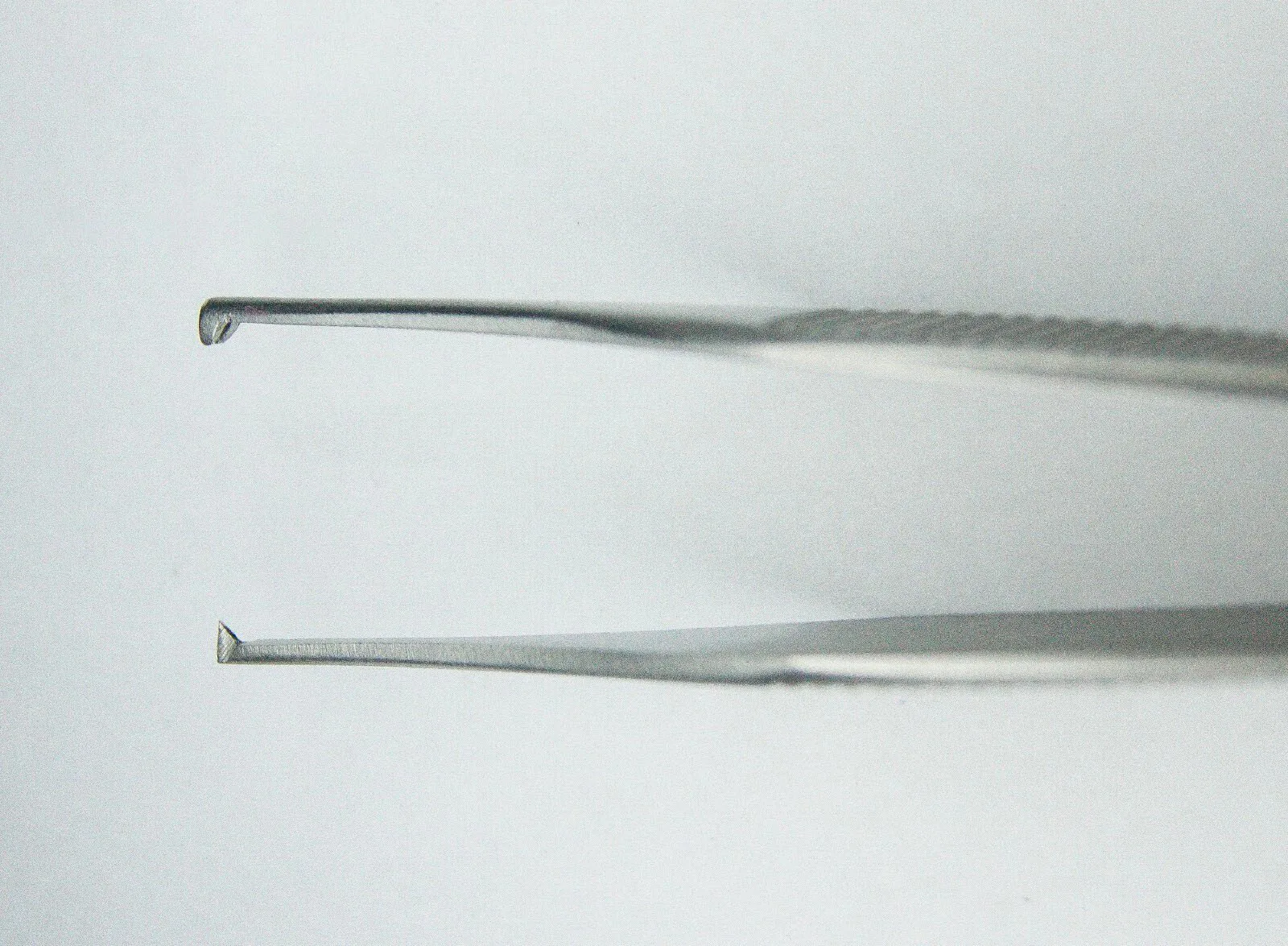
Compare the working ends in our photos
Compare the shape and texture where the jaws meet. Use the listed dimensions when you need to check size.

Thumb forceps and ring-handled forceps
Sort by handle first. Thumb forceps, also called spring forceps or pick-ups, have two arms joined at the back end. They close under finger pressure and spring open on release. Ring-handled forceps have finger rings and usually a ratchet that holds the jaws closed. All three offers in this guide are thumb forceps.
The names tell you different things about the same instrument. “Thumb forceps” describes how the arms close. “Tissue forceps” names a family of grasping instruments. “Dressing forceps” often appears on listings with serrated tips. A single instrument can carry two of these labels, so add the jaw description to the order as well.
Adson 1×2 teeth and serrated dressing jaws
When an order says only “Adson,” look inside the jaws to choose between the two straight 4.75-inch models. Both have a broad thumb rest, so length and outline cannot settle it.
The Adson tissue forceps with 1×2 teeth (DIS-DEN-0183) have interlocking tips. One jaw ends in a single tooth and the other ends in two. When the forceps close, the single tooth seats between the pair. The first photo shows the opposing teeth with the jaws open.
The serrated Adson dressing forceps (DIS-DEN-0182) have narrow working surfaces lined with fine serrations. You may also see this item listed as Adson Tissue Forceps Plain. The second photo shows the serrations on the inner face of the lower jaw.
Look at the inside of the jaws for serrations. The ridges farther back are where your fingers grip the handle. Record teeth, serrations and any tying platform as separate details. Some Adsons combine teeth with cross-serrations, and similar-looking models may have a different platform.
Recognizing Russian tissue forceps
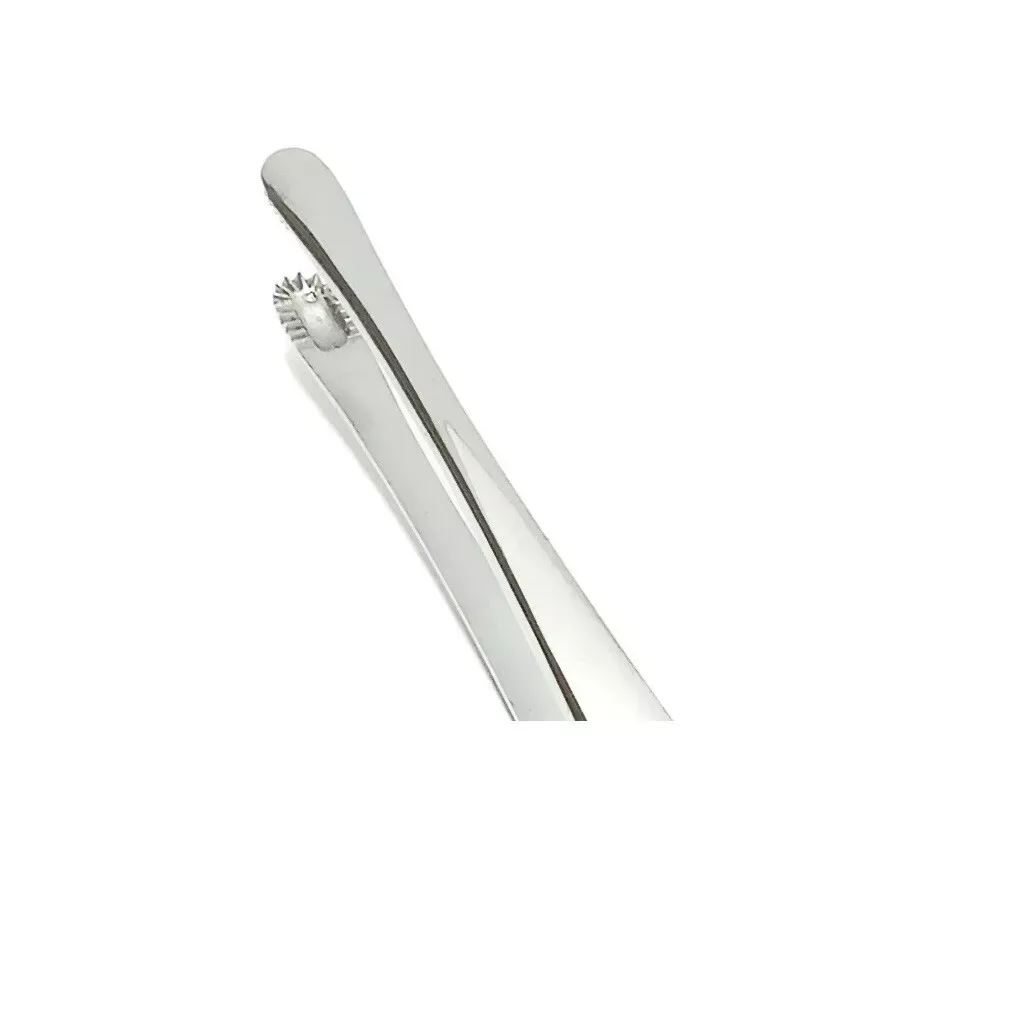
Russian tissue forceps have broad, rounded working heads with teeth at the ends of spring arms. Compared with the narrow Adson tips in the photos, the head shape is the clearest cue. A close-up showing both jaws makes the round profile easy to confirm.
One DIS-SUR-TF-RUS set contains three instruments of the same pattern, each about 6 in (15 cm) long. If your tray needs an exact length or head size, include that measurement in your quote request so we can check it against the instrument we’ll supply.
Other patterns you may see on a tray list
Brown-Adson forceps have multiple rows of fine interlocking teeth on an Adson-like profile. DeBakey tissue forceps are recognizable by the fine grooves running along the jaws. If an old tray list includes either of these names, use the full pattern and maker’s reference when you reorder.
Allis and Babcock forceps both have ring handles and a ratchet. Look at the working end to tell them apart. An Allis typically has interlocking teeth at the tip. A Babcock typically has wider, rounded jaws with an opening.
When the length is known but the jaw is unknown
A recorded length can narrow the choice. The working end tells you which pattern to look for.
- Compare the length with the table. A straight 4.75-inch thumb forceps fits either Adson. A thumb forceps of about 6 in (15 cm) is consistent with the Russian set, but the head still needs checking.
- Open the jaws and inspect the tips. If you see one tooth opposite two, compare with DIS-DEN-0183. For narrow serrated jaws, compare with DIS-DEN-0182. For broad, rounded, toothed heads, compare with DIS-SUR-TF-RUS.
- If you see another feature, such as a platform, an insert or multiple rows of teeth, compare it against the maker’s reference. Send a photo along with the length and any stamped reference so we can help you match it.
How to specify a replacement order
Put the SKU and jaw description on each order line so the person receiving the order can check that the right instrument arrived. Include the length and write the quantity as pieces or sets.
Count in instruments, then convert. The Adsons are sold one at a time, so the instrument count equals the order quantity. Russian forceps come in sets of three, so divide the number you need by three and round up to a whole set. Multiply the set count by three, then subtract the number you need to find how many spares you’ll receive.
For replacements without a SKU, attach a full-length side view that shows the markings and an open-jaw close-up that shows the teeth or serrations.
For example, you may need one of each Adson for six trays and five Russian forceps for the same order. These are the three lines to send.
Checking the replacement against the old instrument
Before a new SKU becomes the tray standard, set the received instrument next to the one it replaces. Start with the written reference. The SKU on the delivery paperwork should match the purchase line, and any reference on the old instrument should match the pattern you ordered.
Next, compare the working ends at the same angle as the photos above. Tooth count, serrations and head shape should agree. Check length only against a figure someone actually recorded, such as 4.75 inches for either Adson. For the Russian set, compare against the figure confirmed on your quote.
Close the jaws of both instruments and compare how the tips meet. Use an intact example of the old instrument, because a bent or worn piece can make a correct replacement look wrong.
If anything differs, keep the replacement aside and send side-by-side photos with the order reference. That gives your supplier the information to check the pattern or quantity before the replacement goes into your trays.
Replacement order checklist
Use the checklist to match the old instrument, write the order and check what arrives.
01Identify the existing instrument
02Write the purchase line
03Check the replacement
What Can Be Confirmed Before You Order
We hold ISO 9001:2015 quality management certification. Request the certificate and its covered organization, site, scope and validity details before ordering. This management-system certification is not a blanket product or destination-market approval.
Sialkot production workflow
Material selection, forming, heat treatment where required, grinding, finishing, inspection, marking, and export packing.
Material02Grade confirmed by SKU
Material and applicable steel grade are confirmed against the quoted pattern instead of applying one grade to every instrument family.
MOQ03Order-type minimums
Samples: 1-3 pieces per pattern; standard product orders: confirmed with your quote; mixed wholesale: 25 instruments (mixed patterns); OEM: 25 pieces per pattern.
Packaging04Protective and branded options
Individual pouches, procedure sets, cassettes, protective bulk cartons, product labels, and approved private-label packaging.
Export05Documented dispatch
Commercial invoice, packing list, protective outer packaging, and courier or freight tracking appropriate to the order.
Types of Tissue Forceps: Adson, Russian and Other Patterns FAQ
Can I get an exact quantity of Russian tissue forceps?
The listed set comes with three forceps. If you need a quantity that isn’t a multiple of three, use the calculator to see the spare count. Ask us for a quote if you need an exact number of individual forceps.
What if the reference on an older pair of forceps has worn off?
Look for the maker and reference on the last purchase order or tray sheet. Send an open-jaw photo and a full side view with your measurements. A second pair from the same tray can help if the old tips are bent or worn.
What does “Plain” mean on the Adson dressing forceps I already have?
On our Adson Tissue Forceps Plain, DIS-DEN-0182, the narrow jaws are serrated. When you’re matching another maker’s model, check its jaw description and close-up, since suppliers use that word for different tip styles.
Sources and Further Reading
Official product and catalog sources support the pattern taxonomy. Always use the instructions supplied with the exact product.
Related Guides
Dental Instrument Identification Chart
A searchable identification reference for dental instrument families, common patterns, easily confused families, and what to verify before ordering.
Read GuideDental Extraction Tray Setup and Instrument List
A practical dental extraction tray setup guide covering the core instruments for simple extraction and the additional instruments used in surgical and retained-root setups.
Read GuideReady to Compare Instruments?
Browse our categories or send your instrument list for manufacturer-direct pricing.