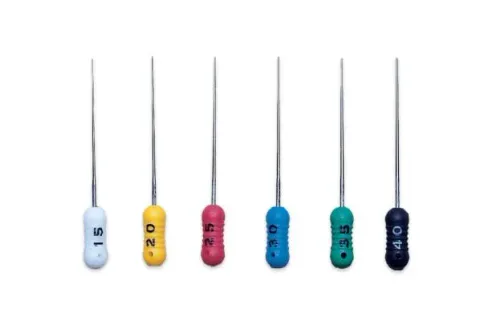
About Finger Spreader
Six finger-held spreaders per pack
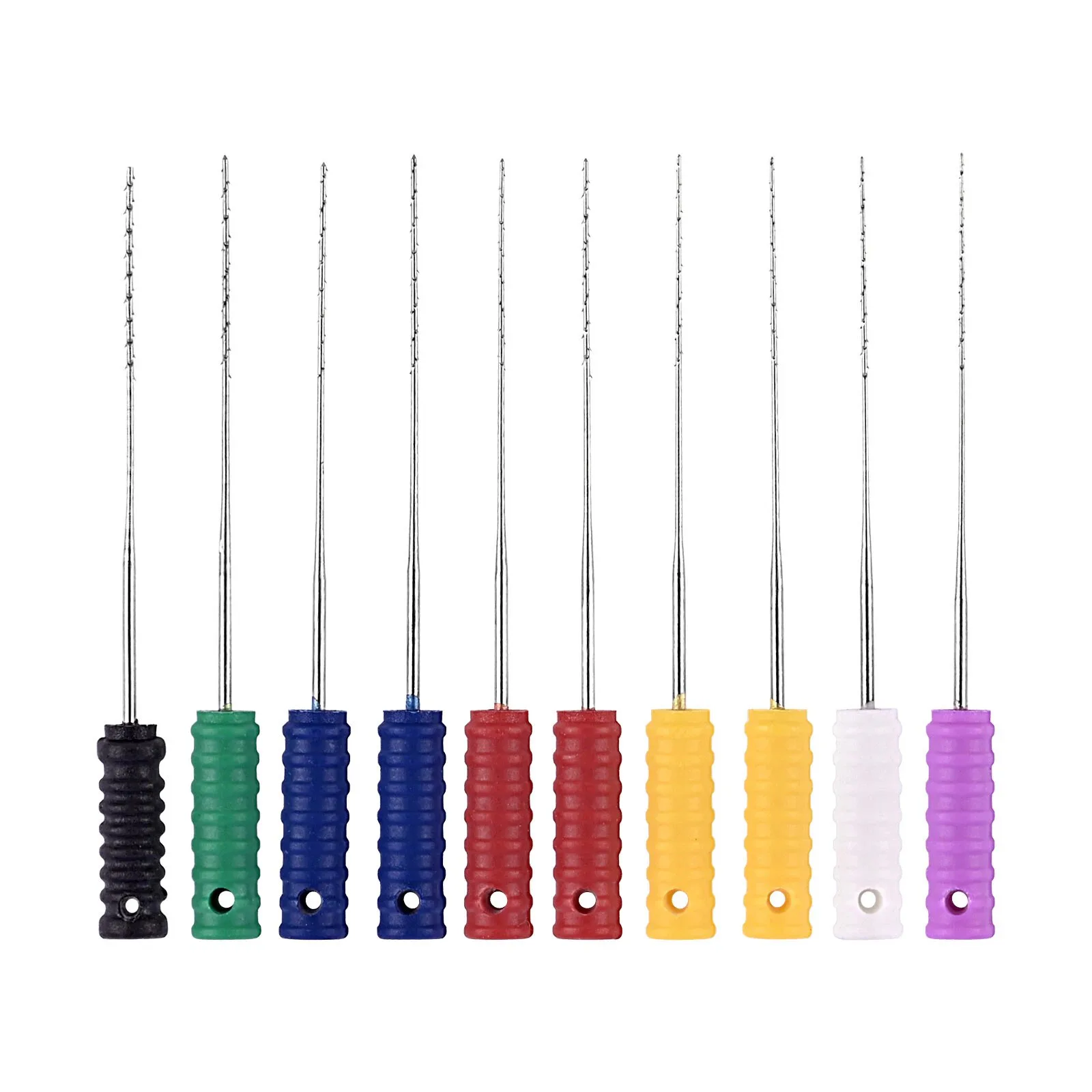
The Finger Spreader comes six instruments to a pack. Each one pairs a short, ribbed finger grip with a tapered, conical working part that narrows to a point. You choose the numeric size and a 21 mm or 25 mm length for your order. The working part is stainless steel, and the handle is PBT (polybutylene terephthalate).
The short grip is what makes this the finger format. It is sized to sit between the fingertips instead of extending into a full-length handle, so the instrument stays compact in the hand. The ribbing gives the fingers a textured surface rather than a smooth one. The pointed taper is the feature that makes it a spreader. It is intended for lateral condensation of gutta-percha, where space is created alongside a placed cone for accessory points. Any tray set up for that approach needs spreaders in the sizes and lengths the practice already works with.
Size, length and pack preference are separate details
A finger spreader order line rests on three independent fields. Combining them into one number makes a request ambiguous. The numeric size refers to the working part. The length is a separate choice between 21 mm and 25 mm. The pack preference states how you would like the six pieces made up. Size 25 and a 25 mm instrument are therefore different requests, and a complete order states both.
- Numeric size: 15, 20, 25, 30, 35 or 40
- Letter reference: 15/XF, 20/FF, 25/MF, 30/F, 35/FM, 40/M
- Length: 21 mm or 25 mm
- Pack preference: Six instruments: request one size or a spread across sizes
Six pieces gives you the count, not the mix. A practice replenishing the spreader size it uses most might prefer six size 25 instruments at 25 mm, while a clinic setting up a new obturation kit might prefer a spread from 15 to 40. Note that preference on the request line, because a six-count does not on its own mean one of each size. The product photograph shows the six sizes side by side to illustrate the range and the grip design. It does not show the contents of a particular pack.
Letter references and the accessory points you already stock
Each numeric size here carries a letter reference, running from XF at size 15 to M at size 40. The letters are useful shorthand on a tray list. However, the same letter does not guarantee the same geometry from one brand to another, and practitioners have noted that spreaders and accessory cones from different makers can differ in shape.
To match this spreader to points already on your shelf, compare three things: the numeric size, the length, and the size or brand reference printed on the accessory-point box. Include all three with your order. If you are moving over from another brand of spreader, add that brand's reference too, so the comparison starts from the same information.
Not a hand spreader, a plugger or a file
Finger spreaders, hand spreaders, finger pluggers and hand files often sit next to each other on tray lists and inventory sheets, and the names blur during restocking.
- Finger spreader: This product. It has the short grip described above.
- Hand spreader: It carries a similar pointed working end on a full-length handle and is a different purchase.
- Plugger: In finger or hand style, it ends in a blunt tip rather than a point, so it does not stand in for a spreader on a tray that calls for one.
- Endodontic file: It shares the finger-held layout but is a cutting instrument made for shaping, which a spreader is not.
Which instrument suits a given case remains the clinician's decision. The order only needs the correct instrument class.
Requesting finger spreader packs
A complete request line keeps the specification clear for first orders and repeats alike. Include SKU DIS-DEN-0215, length, numeric size, your single-size or assortment preference, number of packs and delivery destination. The actual contents of each pack are confirmed in the quotation, so you can review the mix before you order. Send that line to us and we will reply within 24 hours, with a full quote following once the specification has been reviewed.
For cleaning, sterilization and lifecycle decisions, follow the instructions that apply to the delivered model and to your own equipment, as CDC dental infection-control guidance recommends. Our guide to dental instrument cleaning and ultrasonic processing covers the general workflow.