
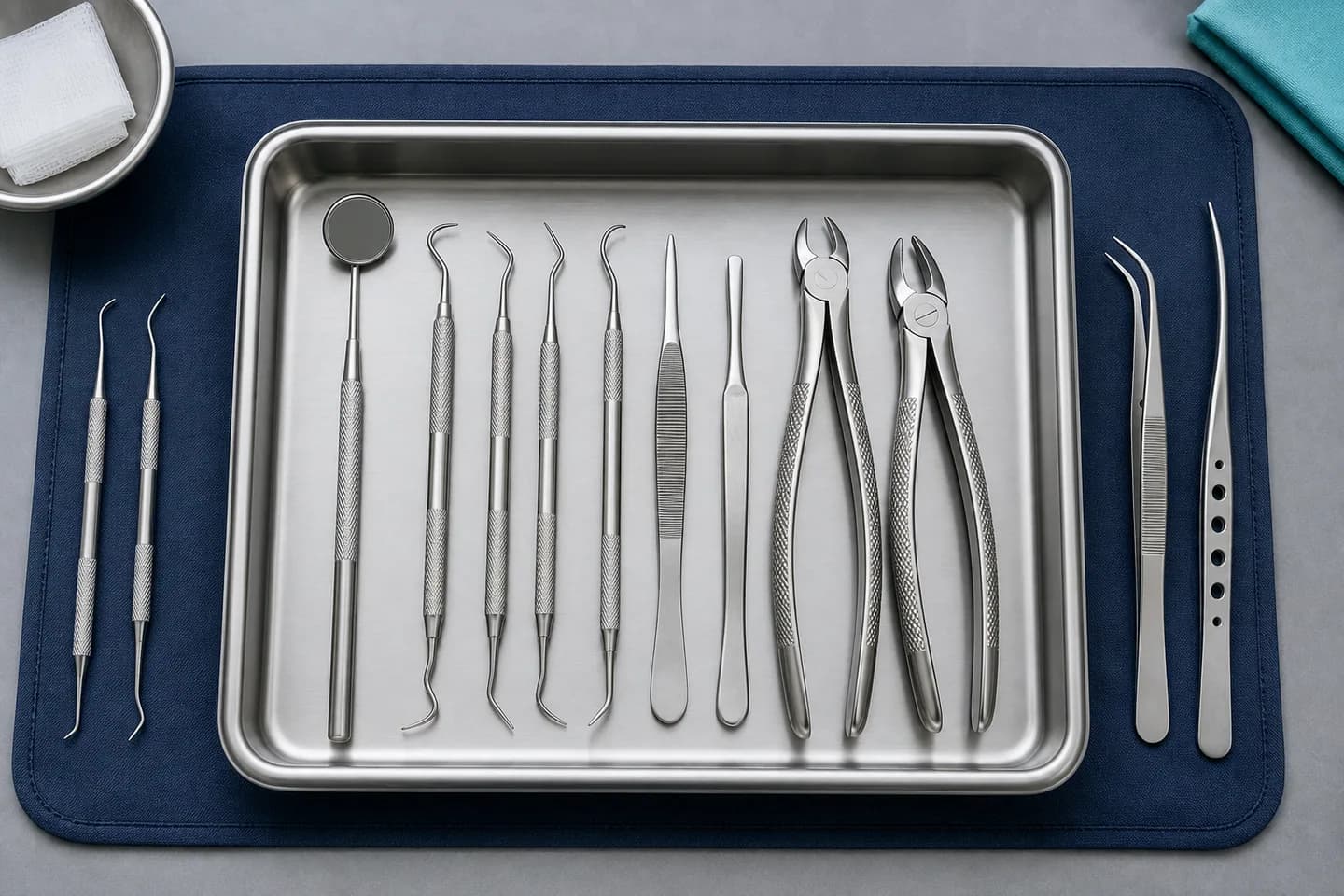
German and Japanese stainless steels are two respected traditions for dental instrument steel, and the practical difference is one of balance: German-style martensitic steels favor toughness and corrosion resistance for durable everyday instruments, while Japanese-style steels are often taken to higher hardness for sharper, longer-lasting cutting edges. For most instruments the steel grade and heat treatment matter more than the country label. This guide compares the two and explains which suits which instrument.
What is German stainless steel in dental instruments?
German stainless steel refers to martensitic instrument grades in the European tradition, commonly around the AISI 420 / 1.4021 family, hardened to a balance of toughness and corrosion resistance. This balance makes it well suited to forceps, elevators, retractors, and general instruments that must resist bending and repeated sterilization rather than hold a razor edge. German-tradition manufacturing is associated with tight tolerances and consistent finishing.
What is Japanese stainless steel in dental instruments?
Japanese stainless steel refers to instrument steels in the Japanese metallurgical tradition, often higher-carbon martensitic grades taken to higher hardness for superior edge retention. This suits fine cutting instruments such as scalers, curettes, and scissors, where a keen, long-lasting edge reduces sharpening frequency. The trade-off for higher hardness is reduced toughness, so these steels are matched to instruments that are not subjected to heavy leverage.
German vs Japanese steel: side-by-side comparison
| Attribute | German-style steel | Japanese-style steel |
|---|---|---|
| Typical priority | Toughness & corrosion resistance | Hardness & edge retention |
| Hardness (typical) | Moderate (balanced HRC) | Higher HRC for cutting edges |
| Edge retention | Good | Excellent |
| Toughness / bend resistance | Excellent | Good (matched to cutting patterns) |
| Best-fit instruments | Forceps, elevators, retractors | Scalers, curettes, scissors |
| Relative cost | Moderate | Often higher |
Which is better for dental instruments?
Neither is universally better; the right steel depends on the instrument's job. Choose toughness-balanced steel for instruments that transmit force, such as extraction forceps and elevators, and higher-hardness steel for cutting instruments such as scalers and curettes and scissors. What determines real-world performance is the grade selection, heat treatment, and finishing applied by the manufacturer, not the country name on the marketing. Our dental instrument materials guide covers the grades and hardness ranges in detail.
How to judge instrument steel when buying
Judge instrument steel by asking for the specifics rather than a country label. Request the AISI grade, the hardness range in HRC, whether the instrument is forged, and confirmation that it is passivated. Then evaluate the finished instrument for even finish, smooth joint movement, and symmetrical working ends, as described in our guide to evaluating dental instrument quality. For cutting instruments, ask about edge retention and whether the pattern is designed to be resharpened.
Frequently asked questions
Is German steel better than Japanese steel for dental instruments?
Neither is better overall. German-style steel favors toughness and corrosion resistance for load-bearing instruments; Japanese-style steel favors hardness and edge retention for cutting instruments. Match the steel to the instrument's function.
What steel is used for dental scalers and curettes?
Scalers and curettes use higher-hardness martensitic steel so their cutting edges stay sharp through use and sharpening. Higher hardness improves edge retention at the cost of some toughness, which is acceptable for cutting instruments.
Does the country of the steel guarantee quality?
No. Quality is determined by the grade, heat treatment, forging, passivation, and finishing applied by the manufacturer. Ask for the grade and hardness and evaluate the finished instrument rather than relying on a country label.
Comparing instruments for your practice? Request a quote and ask us for the exact steel grade and hardness of any pattern.