
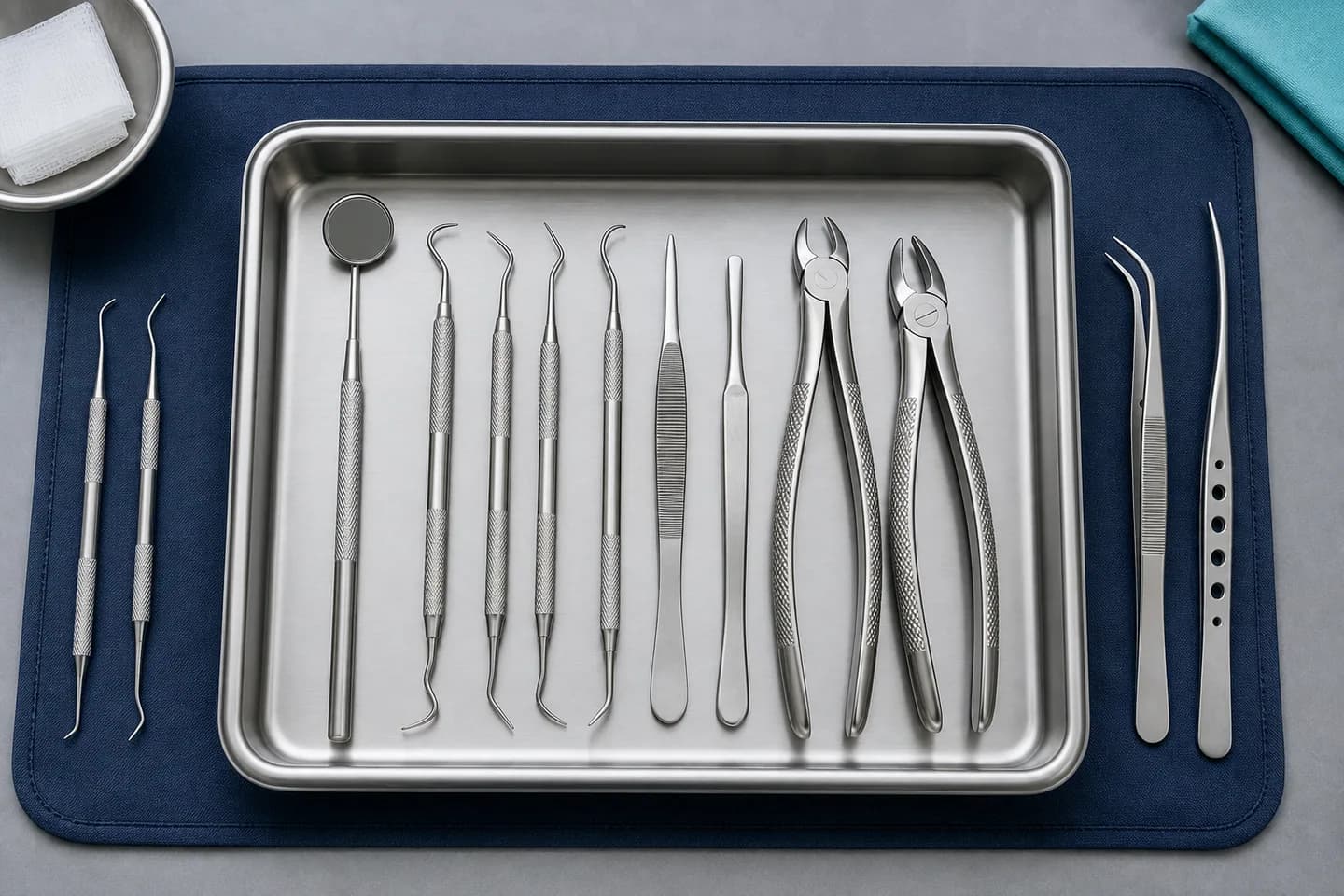
Dental instruments are made by transforming a bar of surgical-grade stainless steel into a precise, sterilizable hand instrument through forging, heat treatment, grinding, finishing, and inspection. The steel grade and the control applied at each stage decide how the finished instrument cuts, resists corrosion, and survives repeated autoclave cycles. This guide walks through the full process a reusable dental instrument goes through before it reaches a practice.
What are dental instruments made from?
Most reusable dental instruments are made from martensitic stainless steel, an iron alloy with at least 12 percent chromium that can be hardened by heat treatment. Cutting instruments such as scalers, curettes, and scissors use higher-hardness grades like the AISI 440 series, general instruments use AISI 420 or 420J2, and non-cutting instruments such as retractors often use tougher austenitic grades like 304. The chromium forms a passive oxide layer that resists rust during sterilization.
The grade is only the starting point. Two instruments cut from the same steel can perform very differently depending on how they are forged, hardened, and finished. For a deeper breakdown of grades and hardness, see our guide to dental instrument materials and stainless steel grades.
How are dental instruments made, step by step?
Dental instrument manufacturing follows a repeatable sequence of forming, hardening, and finishing stages. Each stage is inspected before the instrument moves to the next.
1. Steel selection and die forging
The process begins by cutting stainless steel bar to length and hot-forging it in a die that gives the instrument its rough shape. Forging aligns the internal grain structure of the steel, which produces a stronger instrument than stamping thin sheet metal. Hand-forging is the traditional method used across Sialkot, where skilled workers strike the heated blank into the die.
2. Trimming, milling, and shaping
The forged blank is trimmed of excess metal (flash), then milled and ground to define the working end, joints, and handle. For hinged instruments such as forceps and scissors, the two halves are shaped, box-jointed or lap-jointed, and riveted so they move smoothly.
3. Heat treatment and hardening
The shaped instrument is heated and quenched to harden the steel, then tempered to reach a controlled hardness on the Rockwell C scale (HRC). Forceps and elevators are tempered to roughly 40 to 48 HRC for toughness, while cutting instruments are taken higher, commonly 50 to 58 HRC, so their edges hold longer.
4. Grinding, setting, and finishing
Working ends, cutting edges, serrations, and beaks are ground to their final geometry, and joints are set so beaks meet evenly. This is the stage that most affects clinical feel: edge alignment, smooth joint movement, and symmetrical tips are all decided here.
5. Passivation and surface finishing
The instrument is passivated, usually in a nitric or citric acid bath, to remove free iron from the surface and strengthen the chromium-oxide layer that resists corrosion. It is then given a satin finish (reduces glare) or a mirror polish (smoother, easier to clean).
6. Quality inspection
Each instrument is inspected for dimensions, hardness, joint movement, tip alignment, surface finish, and corrosion resistance. Instruments that fail any check are reworked or scrapped rather than shipped.
7. Marking, cleaning, and packaging
Approved instruments are laser-marked or etched, cleaned, and packaged ready for the customer's own cleaning and sterilization workflow before first clinical use.
Why hand-forging matters
Hand-forged instruments are generally stronger than stamped instruments because forging aligns the steel grain along the instrument, improving strength and edge retention. Stamped instruments cut from flat sheet are cheaper to produce but bend and dull faster, which is why forging remains the standard for professional-grade patterns. This is one of the clearest quality signals a buyer can ask about.
How is quality controlled during manufacturing?
Quality is controlled by measuring the same attributes at every batch: steel grade and traceability, hardness range, dimensional tolerance, joint action, tip symmetry, and passivation. A controlled process produces instruments that match in pattern, weight, and finish across a batch; wide variation between supposedly identical instruments signals loose tolerances. Manufacturers operating an ISO 9001 quality management system document these checks so results are consistent over time. To evaluate instruments yourself, use our guide on how to evaluate dental instrument quality.
From factory to your practice
Buying direct from the manufacturer removes the importer and distributor markups added between the workshop and the practice. Because the instruments are made and inspected in the same facility, feedback about patterns and finishes can move quickly into production, and custom branding or pattern changes are possible on the same line. See how we make instruments in our manufacturing overview, or browse dental instrument categories to compare patterns.
Frequently asked questions
What metal are dental instruments made of?
Reusable dental instruments are made from surgical-grade stainless steel with at least 12 percent chromium. Cutting instruments use higher-hardness martensitic grades such as AISI 440, general instruments use AISI 420 or 420J2, and non-cutting instruments often use austenitic grades such as 304.
Are forged dental instruments better than stamped ones?
Forged instruments are generally stronger because forging aligns the steel grain structure, improving strength and edge retention. Stamped instruments made from thin sheet are cheaper but tend to bend and dull faster.
How long do quality dental instruments last?
Well-made, correctly reprocessed stainless steel instruments last for years of repeated use. Lifespan depends on steel grade, heat treatment, sharpening for cutting instruments, and reprocessing care such as thorough drying to prevent corrosion.
Ready to compare patterns? Request a manufacturer-direct quote with your instrument list and quantities.