
Dental Implant Instruments and Surgery Kits
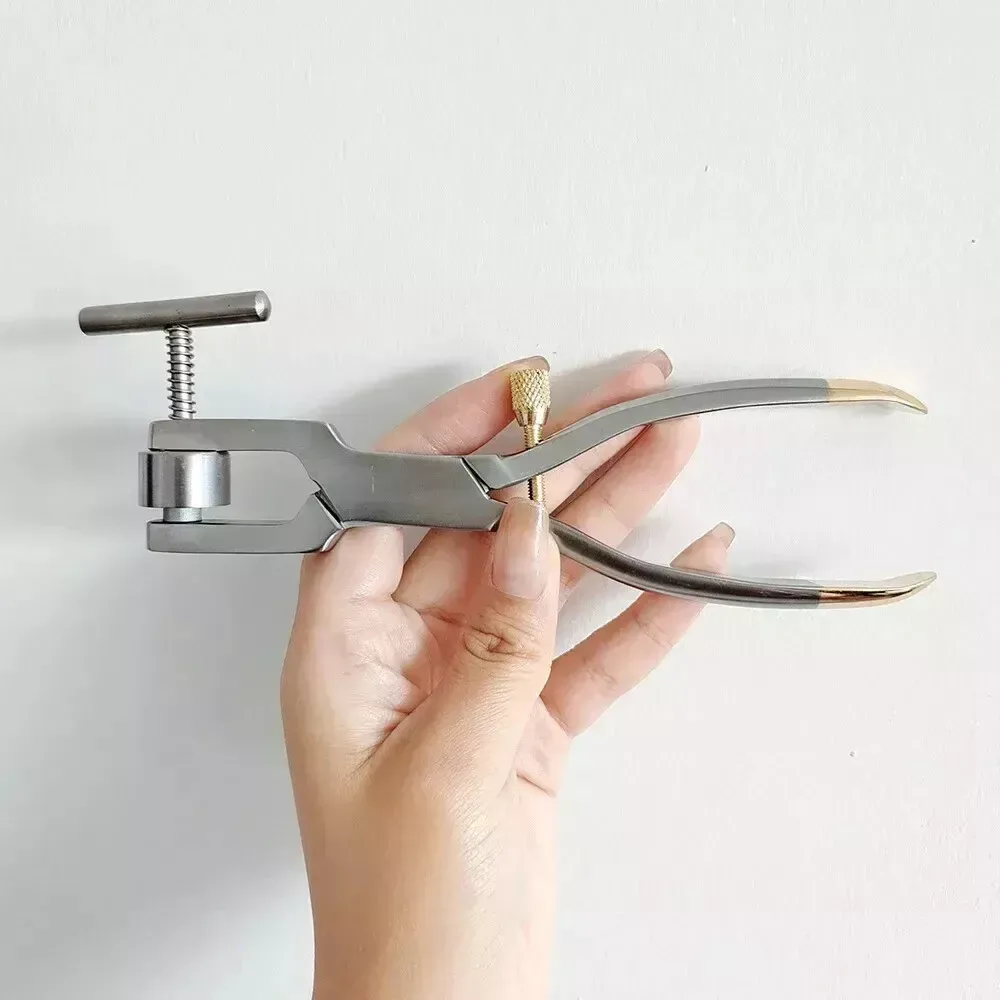
Manual Bone-Crushing Pliers
Hand-operated bone-crushing pliers with a round chamber and a T-shaped adjustment screw, for crushing pieces of harvested bone into particles for grafting.
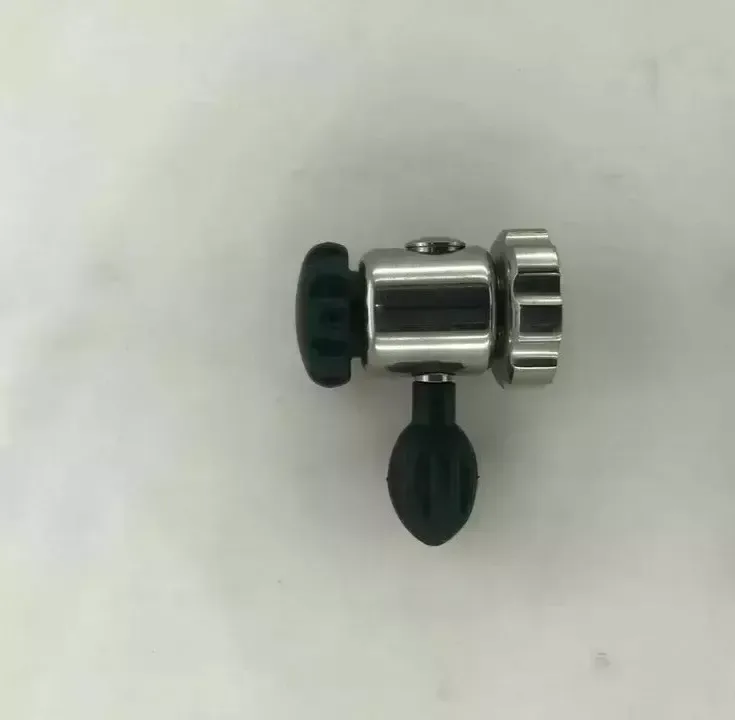
Manual Rotary Bone Mill
Hand-turned rotary bone mill with a cylindrical body and black side handles, for grinding pieces of harvested bone into particles for grafting.
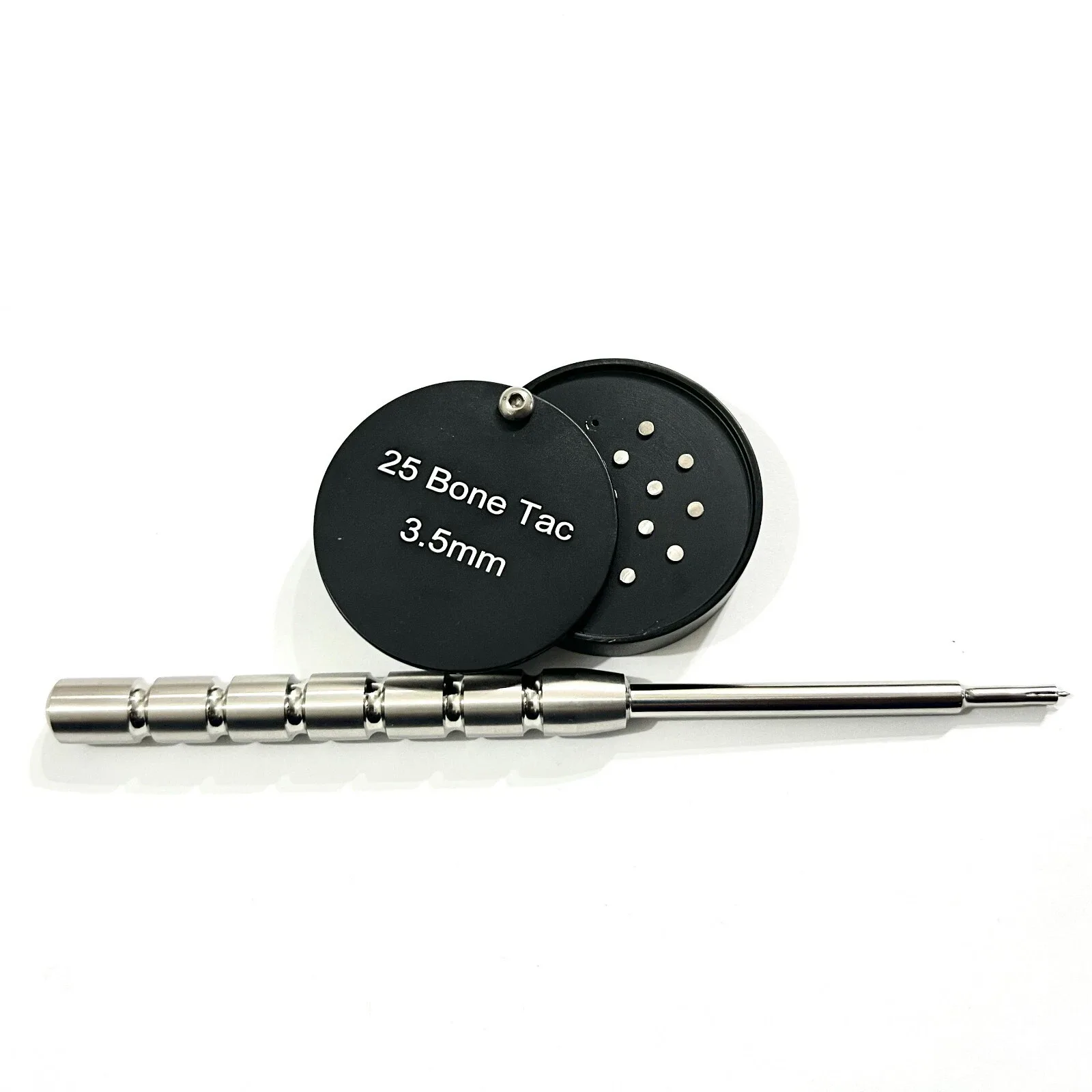
Membrane Placement Set
Membrane fixation set: 25 short bone-tack pins listed at 3.5 mm long in a labelled holder, one ring-grip placement instrument, and a storage and sterilisation box.
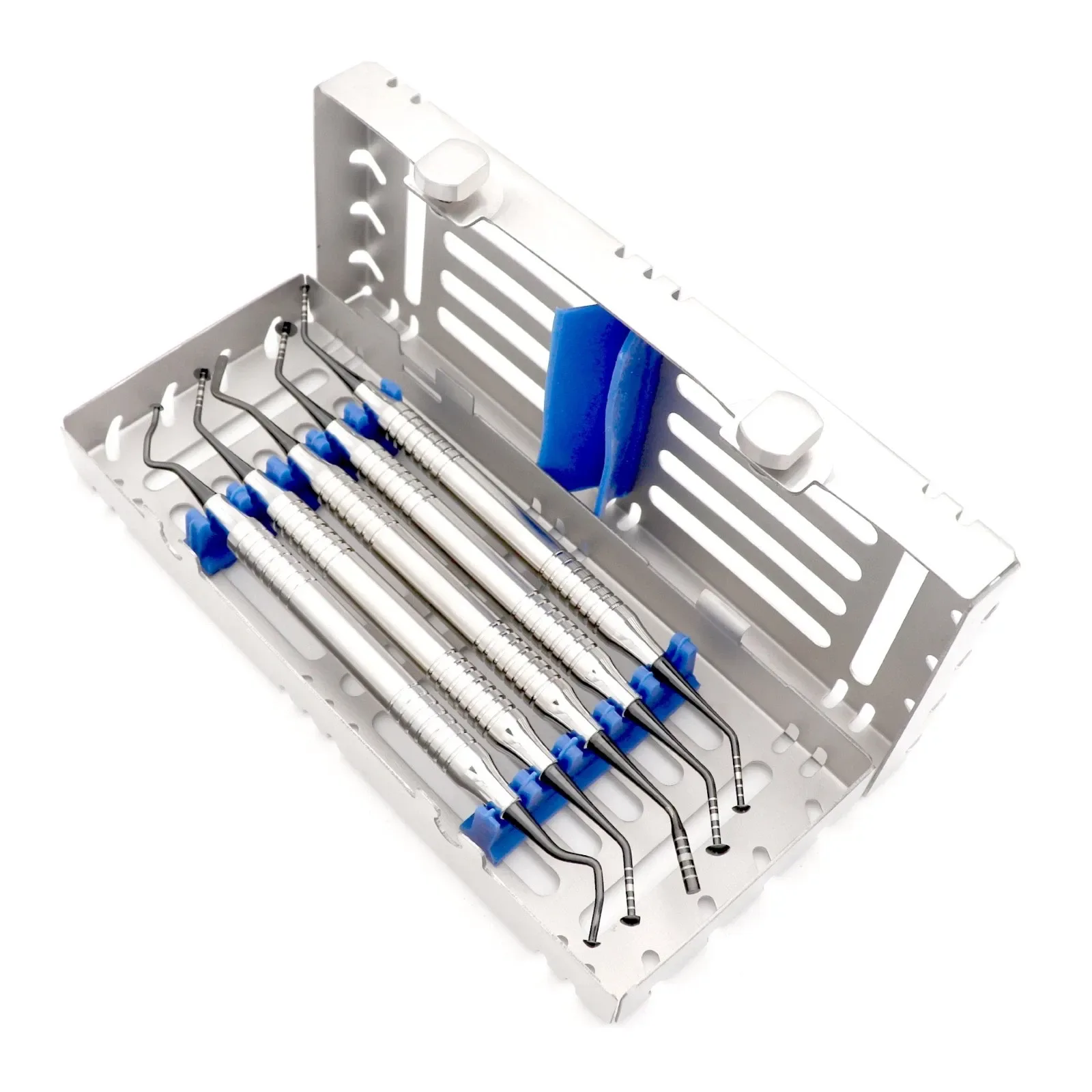
Mushroom Sinus Lift Instrument Set, 5 Pieces
Five double-ended sinus lift hand instruments with round, disc-shaped “mushroom” tips for lifting the sinus membrane away from the bone, supplied in a matching metal cassette.
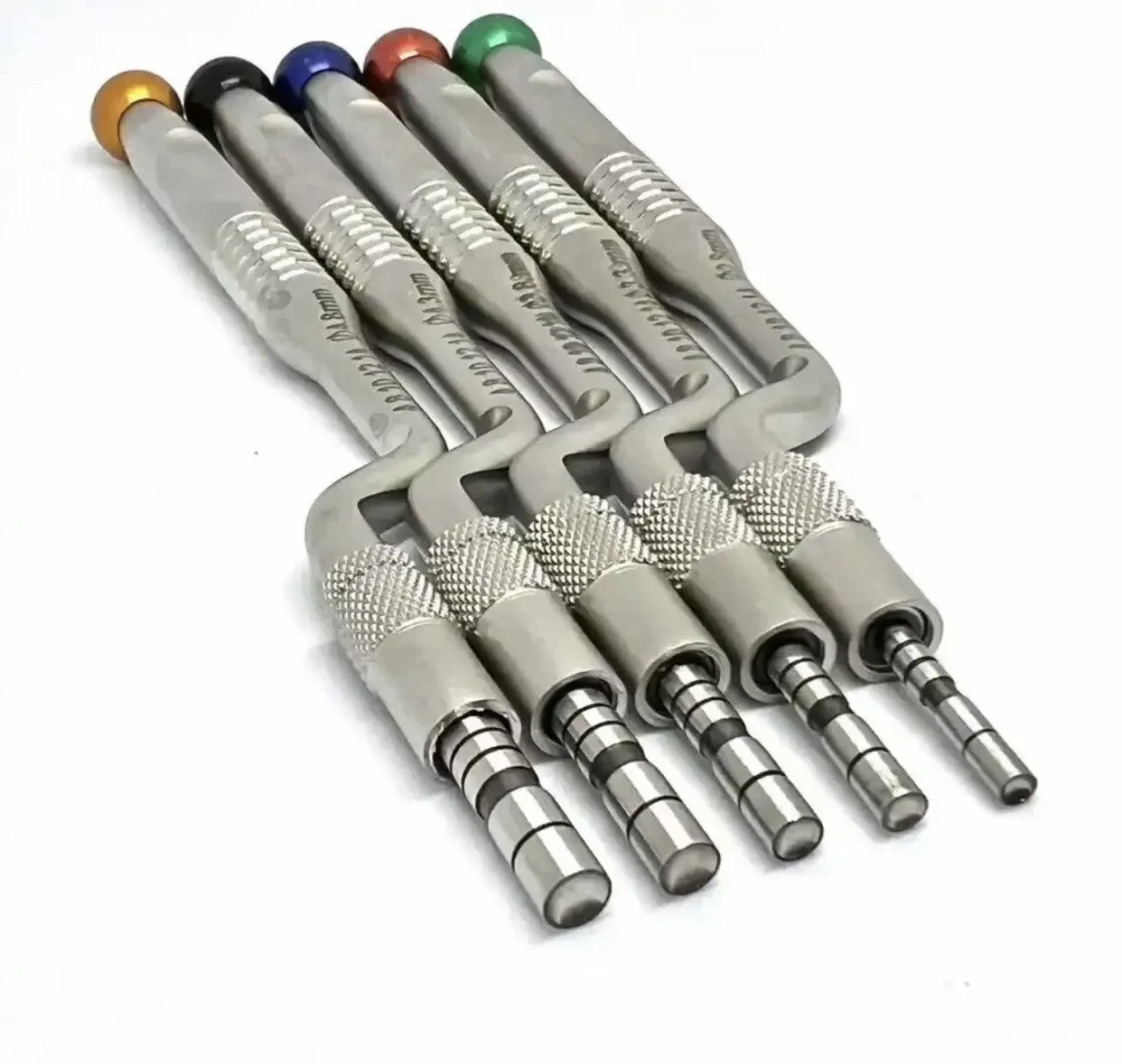
Offset Concave Osteotome Set, 5 Pieces
Five manual offset concave osteotomes, one at each nominal diameter of 2.8, 3.3, 3.8, 4.3 and 4.8 mm. Every instrument in the set has an offset shaft and a concave working end.
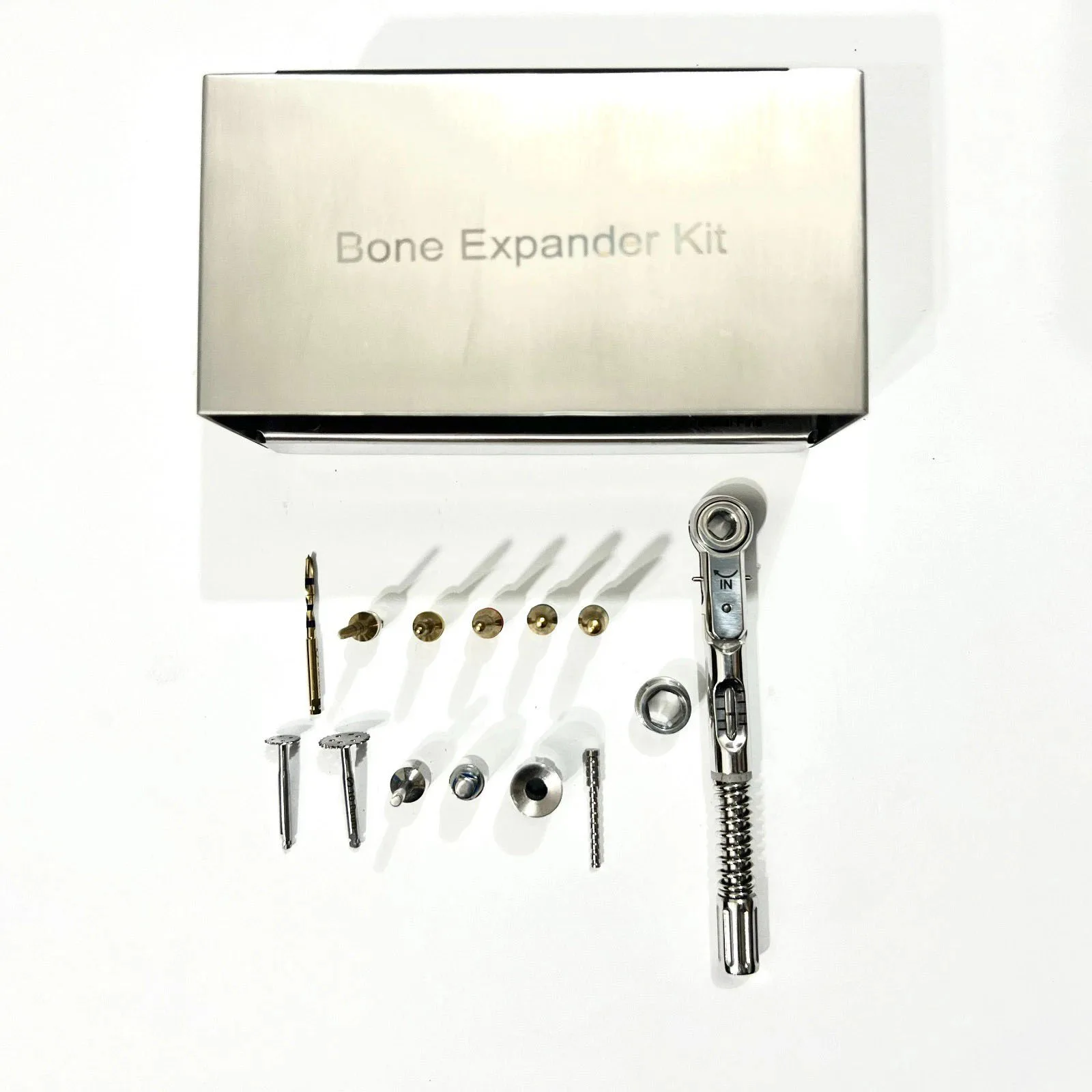
Saw Disc Kit
Two saw discs, 7 mm and 10 mm in diameter, supplied with five expansion screws, a pilot drill, a long pin, and driving accessories, all held in a sterilization organizer. The driving accessories are a 10–40 Ncm torque wrench, ratchet extender, 4 mm motor-mount adapter and hand driver.
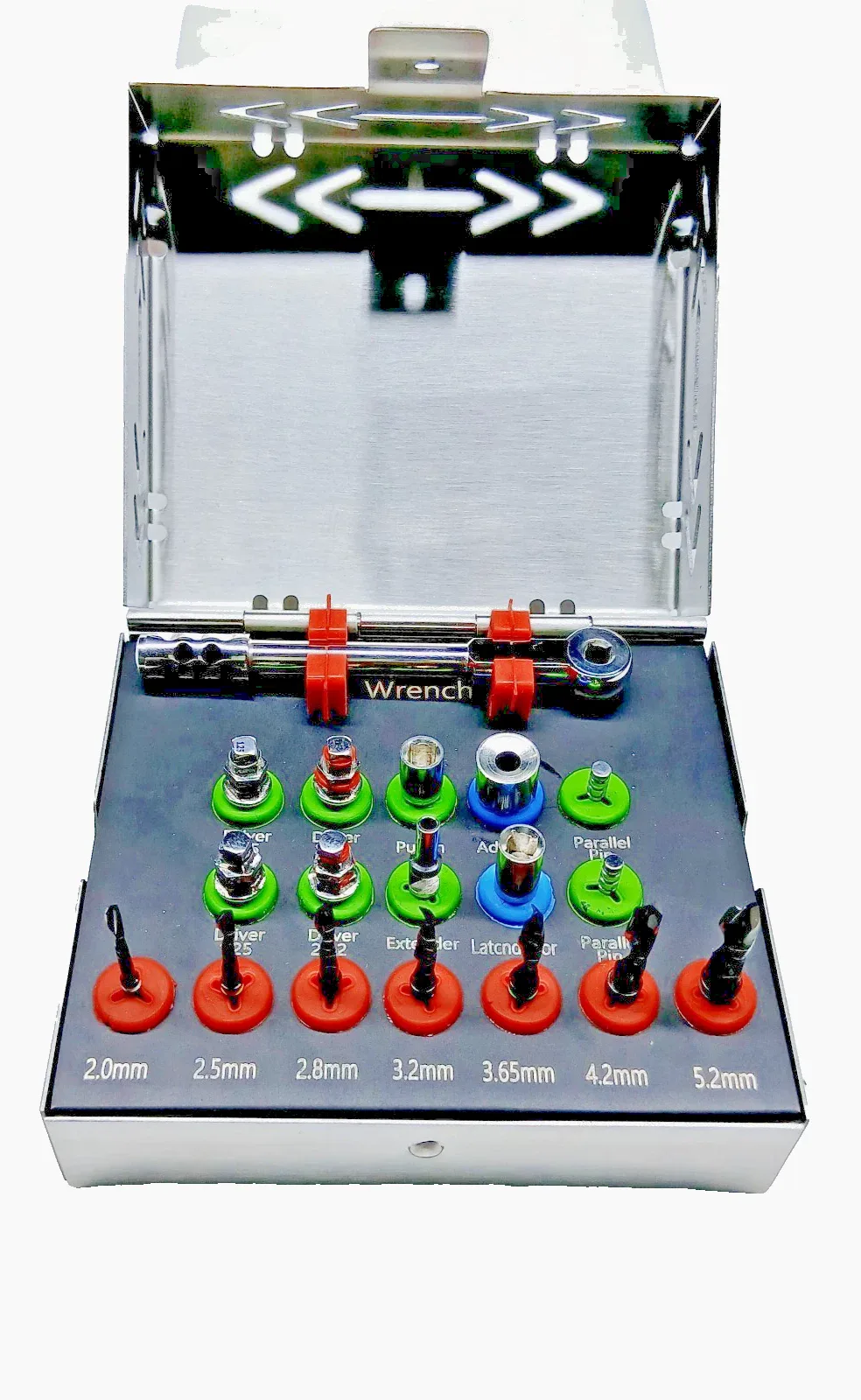
Twist Implant Drill Kit
Five external-irrigation twist drills (2.8, 3.2, 3.65, 4.2 and 5.2 mm) supplied with a marking drill, a pilot drill, parallel pins, a drill extender, latch and ratchet-key drivers, a 6.35 mm hex ratchet wrench and a hand-wrench adapter.
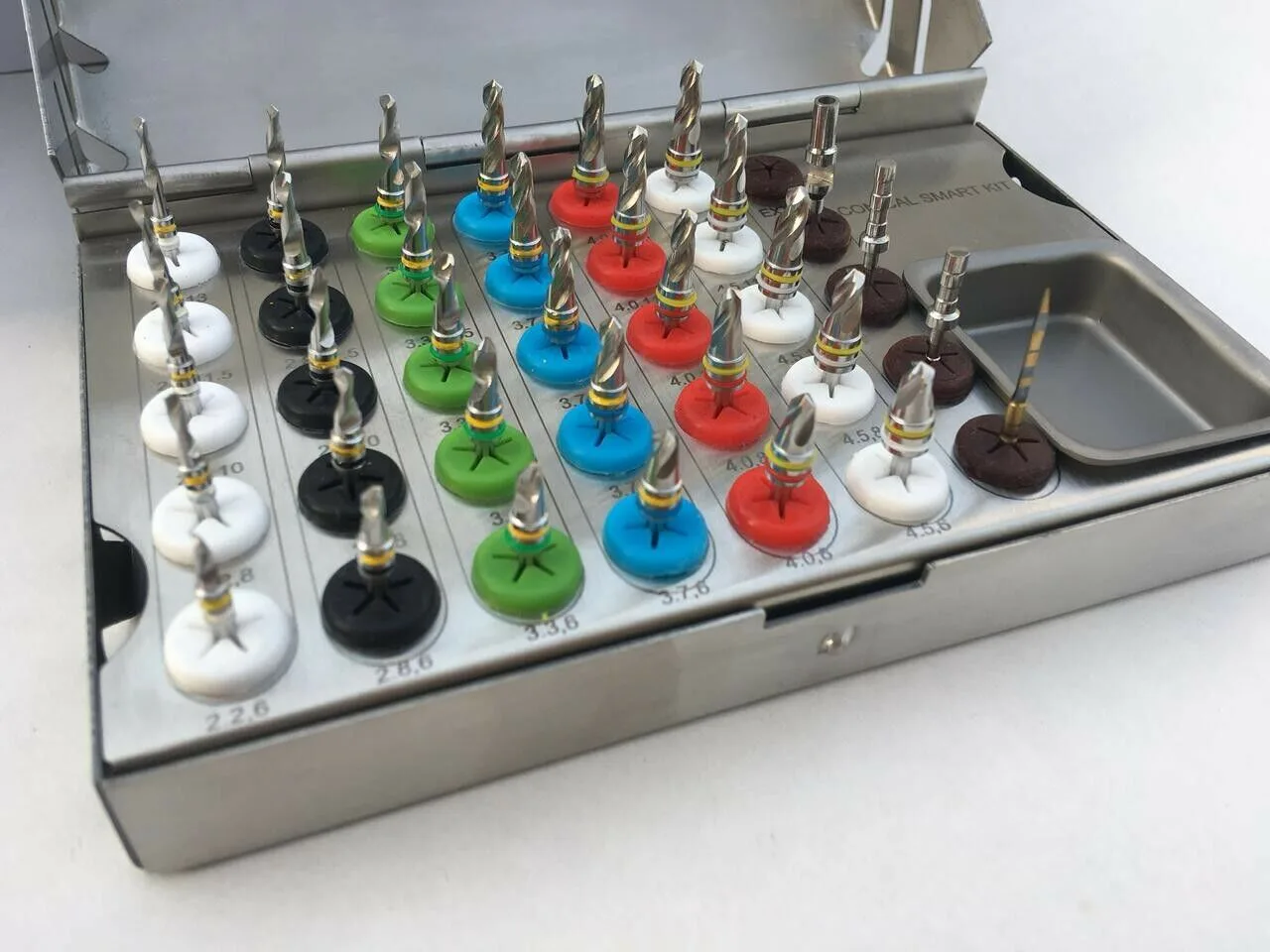
Twist Stopper Drill Kit
30 conical twist drills in an organized metal case. Each drill sits under one of six diameter labels (2.2–4.5 mm) and one of five length labels (6–13 mm). A separate accessory group is housed alongside the drills.
Universal Bur and Trephine Kit
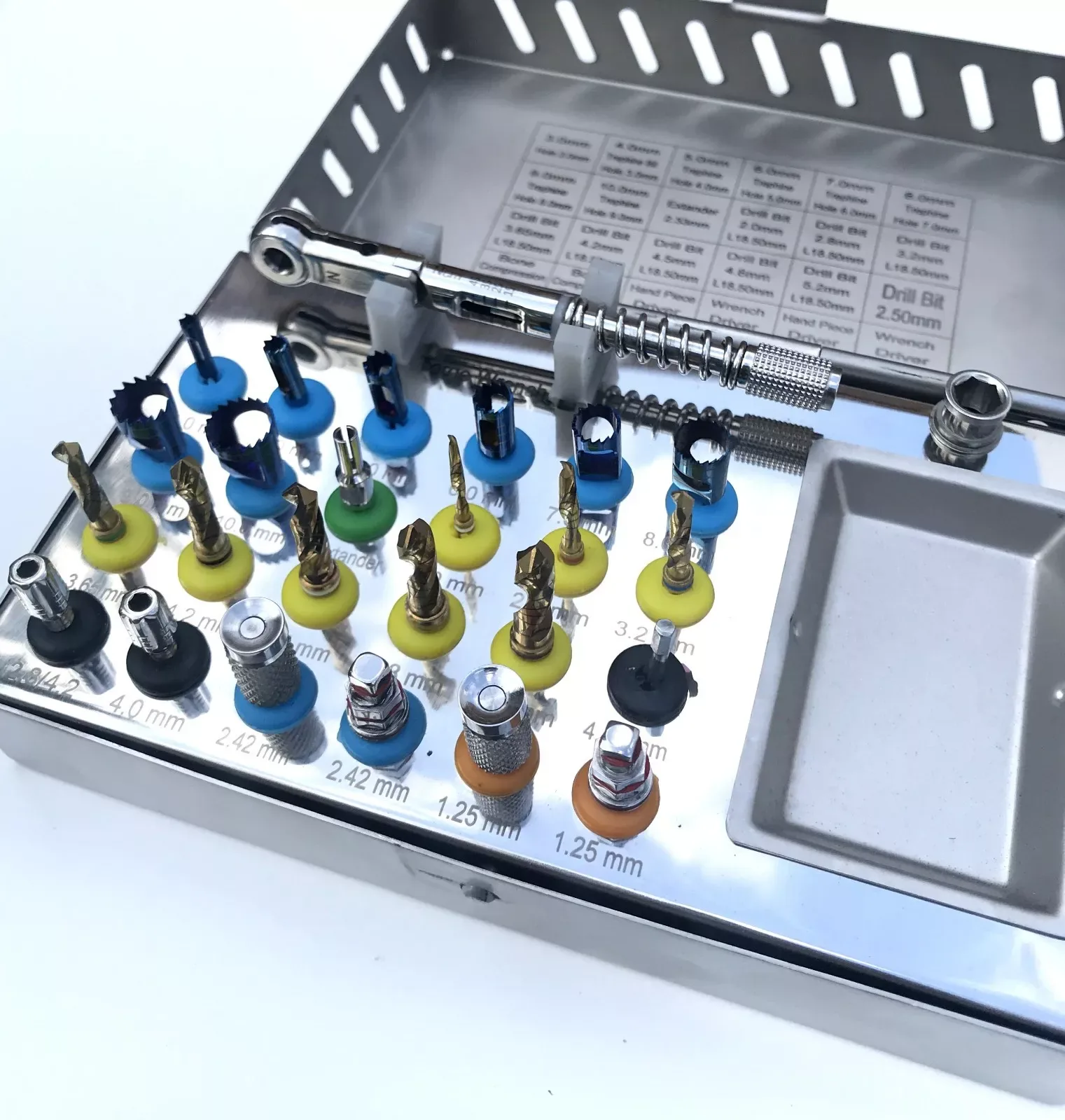
A 25-instrument set with eight titanium-coated trephines from 3 to 10 mm and eight titanium-coated drills from 2 to 5.2 mm. It also includes a 10–40 Ncm torque wrench, hex and handpiece drivers, a ratchet extender, an extender and compression screws, all in a storage box.
Universal Implant Surgical Kit
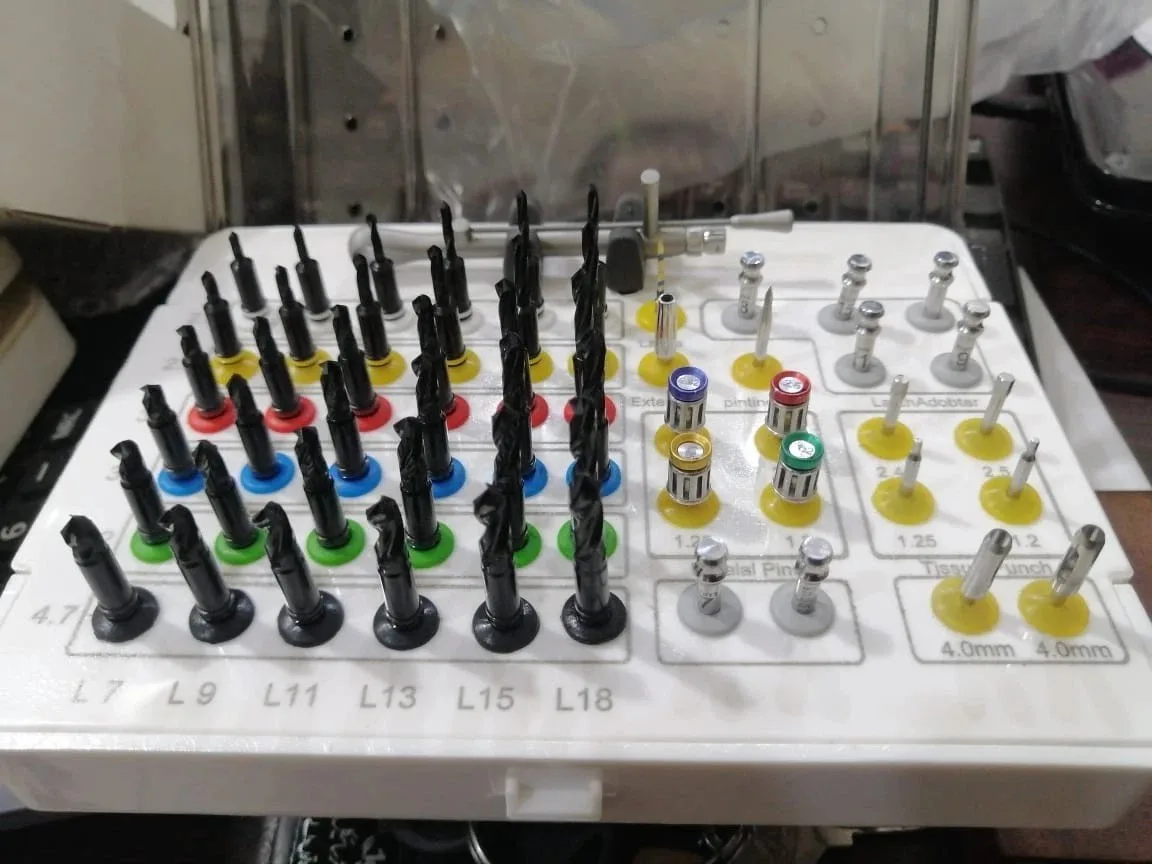
Implant surgical assortment with 36 drills marked L7 to L18 in a six-by-six layout, plus driver and extender, pins, two 4.0 mm punches, colour-coded cylindrical accessories and a wrench.
Browse Dental Implant Instruments and Surgery Kits by Type
Narrow the range to the instrument family that matches the pattern or procedure you need.
Implant Drill Kits
An eight-drill surgical kit (2.0 to 5.2 mm, depth-marked) and conical drill and stopper kits in 25 to 55 pieces. Compare drills, s...
Compare Product FamilyGuided Implant Surgery Kits
Implant positioning kits with a 2.0 mm pilot drill and guides from 6.0 to 12.0 mm, plus a 15-piece option with 4 and 4.5 mm tissue...
Compare Product FamilyBone Expansion & Osteotome Kits
Screw-type bone expander kits (2.6–4.3 mm), a five-piece offset concave osteotome set (2.8–4.8 mm) and a nine-piece chisel and mal...
Compare Product FamilyBone Grafting & GBR Kits
A four-drill bone collector set (3.4, 4.0, 4.2, 5.2 mm) with metal holder, and GBR bone tack kits with titanium tacks in 2.5 and 3...
Compare Product FamilyImplant Prosthetic Instruments
A three-piece collet-style holder that grips an implant abutment outside the mouth while it is shaped in the laboratory. Not a dri...
Compare Product FamilyImplant Microsurgery Kits
A four-piece microsurgery set (needle holder, scissors, tweezers, scalpel handle) with cassette, and a five-instrument soft brushi...
Compare Product FamilyDental Implant Instruments and Surgery Kits Buying Specifications
| Specification | Details |
|---|---|
| Osteotomy | Drill type, diameter progression, working length, depth marking or stopper, shank, irrigation, and cassette |
| Guided surgery | Guide or sleeve interface, drill sequence, key or handle, pins, depth control, and system compatibility |
| Bone and soft tissue | Expanders, osteotomes, chisels, sinus lift instruments, graft tools, GBR tacks, trephines, tissue punches, saw discs, PRF, and microsurgery instruments |
| Restoration side | Abutment holder body, collars and collet-insert sizes; drivers and torque tools only where the interface is documented |
| Order details | Workflow, system or interface, dimensions, component schedule, replacements, cassette, quantity, packaging, and destination |
Dental Implant Instruments and Surgery Kits FAQ
How do I choose the right implant-instrument collection?
Start with the purchasing task: drilling, guided positioning, bone expansion, graft collection or fixation, prosthetic driving, or fine soft-tissue instrumentation. These groups have different contents and interfaces. Open the corresponding narrower collection before comparing configurations, so a broad implant kit request does not mix instruments intended for different requirements.
How does a guided kit differ from a conventional drill assortment?
A guided configuration adds a defined relationship between the drill, sleeve, guide and associated key or handle. A conventional drill assortment can provide selected drill sizes without that matched guidance interface. Compare the actual components and system references; a kit name or a stopper does not establish a fully guided arrangement.
What does universal mean when comparing implant instrument kits?
Treat universal as a range description and check the documented interfaces for the selected components. Drill shanks, sleeves, drivers and screw profiles have their own matching requirements. Use the exact system and component references in the comparison; a broad label or familiar diameter cannot establish fit across every implant or guide system.
Why should instruments, accessories and cases be compared separately?
Advertised totals can include different kinds of items. A holder, stopper, driver or container should have its own line in the contents schedule. Comparing those lines shows the actual drilling or hand-instrument assortment and prevents a larger piece count from being mistaken for more drills or wider system coverage.
Is the abutment preparation holder an implant driver or torque tool?
No. It is a three-piece collet-style holder that grips an abutment outside the mouth while it is shaped in the laboratory, and its collar threads tighten the collet; they are not an implant screw connection. Drivers and torque tools are separate instruments with their own documented interfaces.
How should implant replacement components be identified?
Start with the original kit and component reference. For a drill, retain geometry, measured length and connection details; for a driver, retain its tip profile and connection; for a tack, retain its matched placement-tool reference. Use the relevant component fields rather than treating one nominal size as a complete replacement specification.
Need Dental Implant Instruments in Bulk?
Send your instrument list and quantities for manufacturer-direct pricing, custom branding, or mixed-category quotes.